
Posted by THREEPIECE.US on Apr 24th 2026
2009-2011 Nissan GT-R R35 Buying Guide: CBA Under $50K
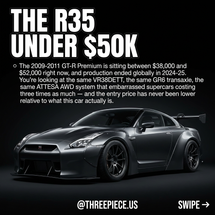
The 2009-2011 Nissan GT-R Premium is sitting between $38,000 and $52,000 right now, and with global R35 production wrapped up in 2024-25, the floor on these CBA cars isn't going to hold. You're looking at the same VR38DETT, the same GR6 dual-clutch transaxle, and the same ATTESA E-TS AWD system that embarrassed supercars costing three times as much when it debuted — and the entry price has never been lower relative to what this car actually delivers. If you've been watching R34 prices climb into six figures while ignoring the R35, this is your correction.

Quick links
- Why Sub-$50K Pricing Is an Anomaly
- Lower Boost, Bigger Gains: The CBA Tuning Advantage
- The GR6 Transmission: What Actually Breaks
- The Pre-Purchase Checklist That Saves You $15K
- R35 Wheel Fitment and Brake Considerations
- Stop Waiting — The Window Is Closing
Why Sub-$50K Pricing Is an Anomaly
Everyone fixated on the R34 Skyline GT-R as the appreciating JDM asset while the R35 quietly sat in depreciation's trough. That made sense when the car was still in production and newer model years were incrementally better. Now that production is over, the math changes. A 2009 GT-R Premium with reasonable mileage is trading for less than a new Mustang Dark Horse — except it makes 480 hp stock through a twin-turbo V6, puts power to all four wheels through one of the most sophisticated AWD systems ever built, and has a clear, community-proven path to 600 whp on the stock bottom end.
Compare that to the 981 Cayman buying guide we published — another sub-$50K performance car with real upside. The GT-R plays in a completely different power bracket. The Cayman is the better driver's car in isolation, but the R35 is the better platform if outright speed and tuning potential are the priority. These two cars represent the best performance values under fifty thousand dollars in 2026, and neither will stay there.
Lower Boost, Bigger Gains: The CBA Tuning Advantage
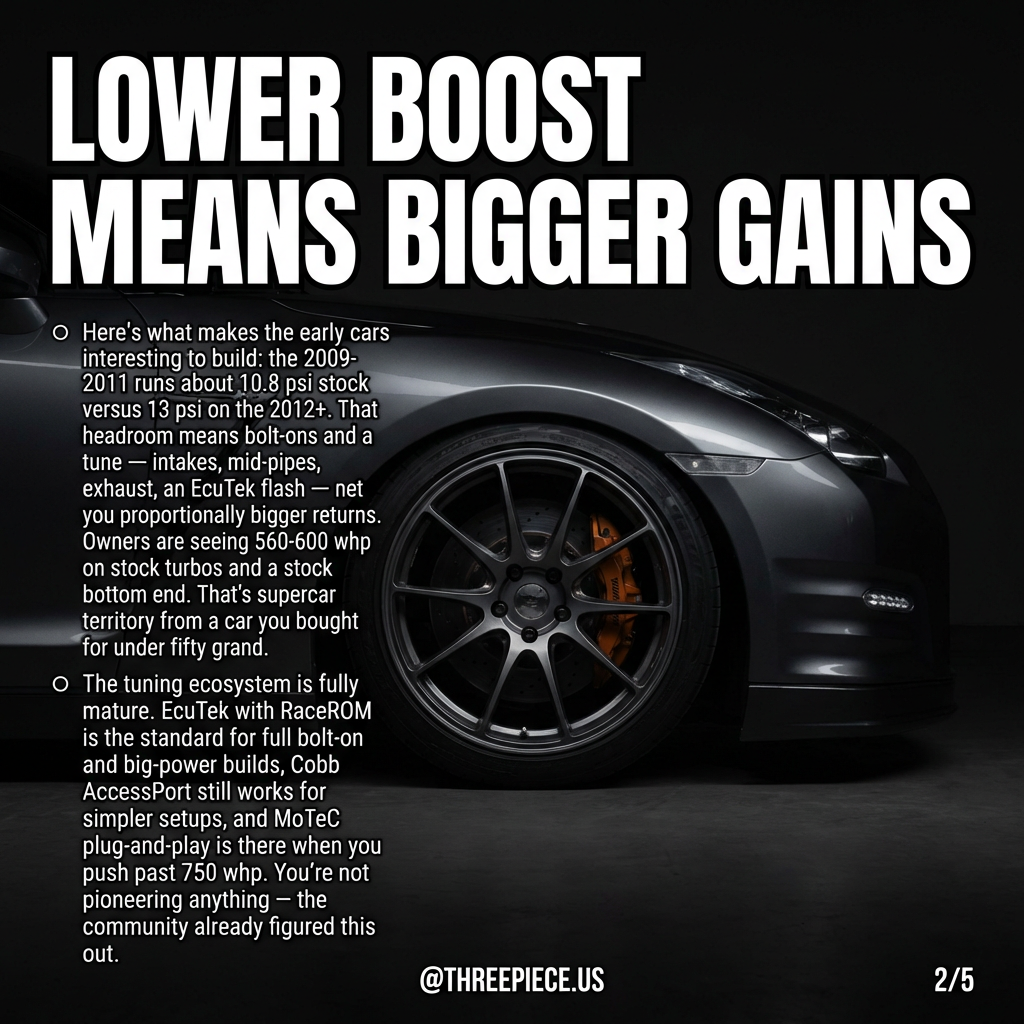
Here's what makes the 2009-2011 cars specifically interesting to build: the CBA runs about 10.8 psi stock versus 13 psi on the 2012+ DBA models. That lower baseline means bolt-ons and a tune net you proportionally bigger returns on the early cars. Owners are consistently seeing 560-600 whp on stock turbos and a stock bottom end with intakes, mid-pipes, exhaust, and an EcuTek RaceROM flash. That's genuine supercar territory from a car you bought for under fifty grand.
The tuning ecosystem is completely mature. EcuTek with RaceROM is the standard for everything from full bolt-on to big-power builds. Cobb AccessPort still works for simpler setups. MoTeC plug-and-play is there when you push past 750 whp. You're not pioneering anything — the R35 community figured all of this out years ago, and the data is documented across thousands of builds. If you want to understand how stage 1 vs stage 2 tuning works in practice, the R35 is one of the best case studies in the sport-compact world.
For builds above ~30 psi / 650+ whp, owners generally upgrade rods, pistons, move to hybrid or GT4500+ turbos, upgrade the fuel system (ID1700 injectors, dual pumps), and do a full transmission rebuild with upgraded clutches. Below that threshold, the stock internals hold — but you need to be honest about where that line is. Connecting rods start bending around 600 ft-lb of torque in hard-driven cars. The Clevite VR38DETT Con Rod Bearing Set at $58.51 is cheap insurance if you're doing any internal work or preemptively addressing rod bearing wear — a known weak point once these engines see sustained high loads.
The GR6 Transmission: What Actually Breaks
Every R35 purchase decision comes down to the transmission. The GR6 dual-clutch in these early cars has specific, well-documented failure modes — and understanding them is the difference between buying a solid car and inheriting someone else's problem.
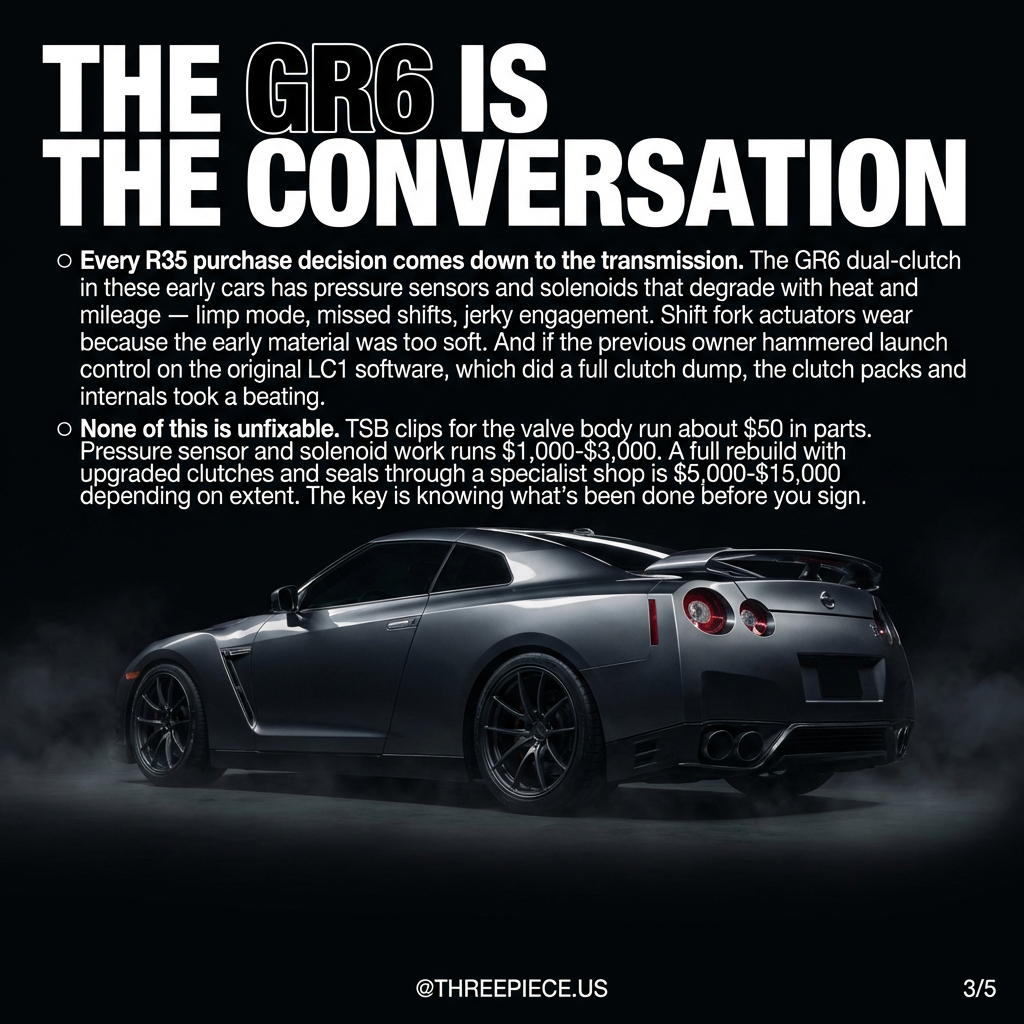
Pressure sensors and solenoids are the most common issue. The GR6 has three pressure sensors (main line + two clutch pressures) that are heat-sensitive. When one fails, the car goes into limp mode with delayed or improper shifting. Solenoids controlling clutch actuation degrade from debris, wear, and heat — often after about 60,000 km (~37,000 mi) or when fluid has never been changed. Repair cost: $1,000-$3,000.
Shift fork actuator wear is specific to the 2009-2011 cars. The early actuator material was too soft, and the square edges wear down, causing misalignment. Symptoms include odd/even gear mis-shifts or failure to engage 2nd, 4th, or 6th. The fix is updated "TSB clips" that align the magnetic sensors and secure pistons in the valve body — about $50 in parts if you're doing it yourself or having a specialist handle it during a service.
Launch control damage is the big one. The original launch logic ("LC1") in 2009 models did a full clutch dump off RPM, sending massive shocks through the drivetrain. That setup wrecked clutch packs, synchro gears, and entire transmissions. Nissan released LC2 which replaced the dump with slip-control. If the previous owner hammered LC1 repeatedly, the internals took a beating. Ask specifically whether the software was updated — if they don't know, assume the worst and price the car accordingly.
A full rebuild with upgraded clutches and seals through a specialist shop (Shep Trans, Dodson, etc.) runs $5,000-$15,000 depending on extent. A new replacement transmission from Nissan costs $25,000-$30,000+. The GR6 demands fluid changes (Pentosin FFL-2 or OEM spec) every ~37,000 miles plus filter and valve body cleaning. Skipping service accelerates every single failure mode listed above. If you want to understand how intake modifications affect the broader powertrain, the R35's integrated systems make this more consequential than on simpler platforms.
The Pre-Purchase Checklist That Saves You $15K
Before you hand anyone money for a CBA GT-R, run through every single one of these:
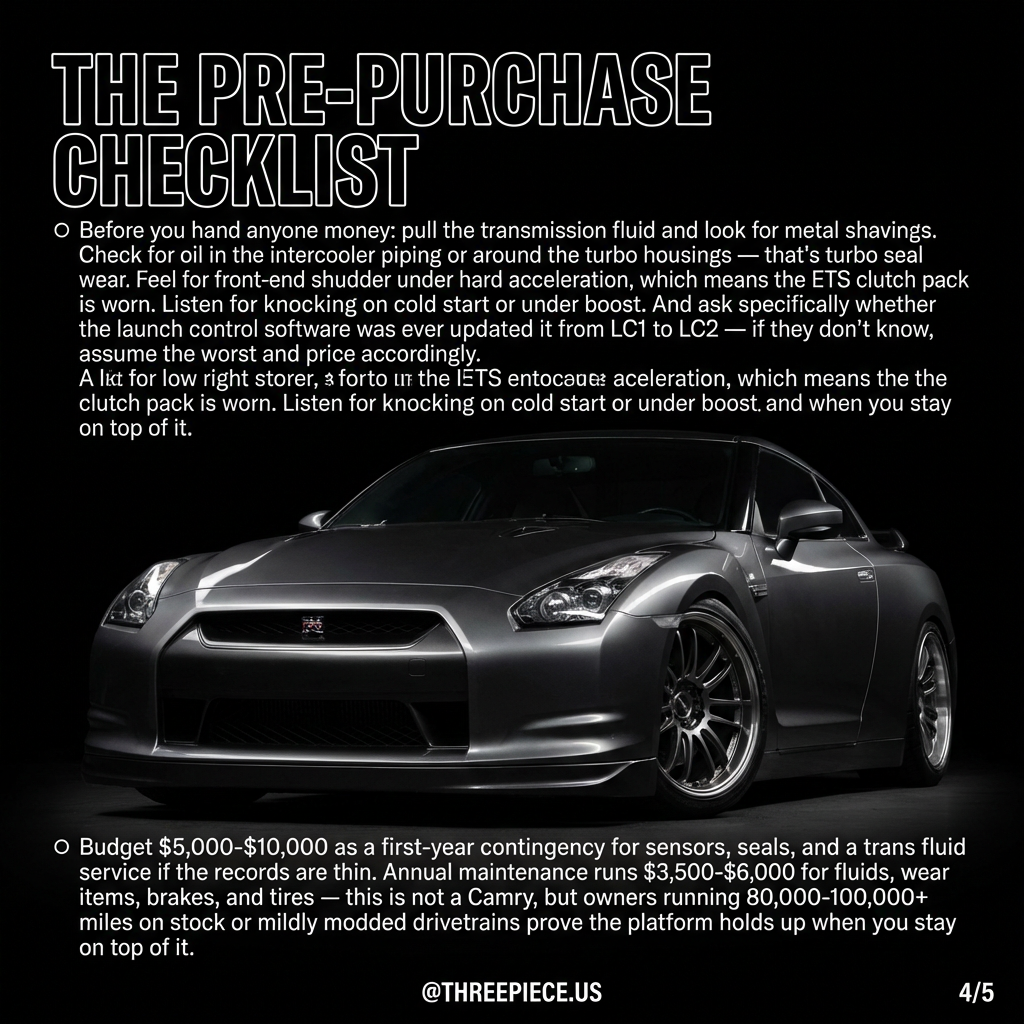
- Pull the transmission fluid and look for metal shavings. Any metallic debris means internal wear is already happening.
- Check for oil in the intercooler piping or around the turbo housings — that's turbo oil seal wear. Repair runs $500-$2,000 depending on whether you're resealing or replacing turbos entirely.
- Feel for front-end shudder under hard acceleration. This indicates the ETS (electromagnetic torque split) clutch pack is worn — the front differential output shaft may need rebuilding.
- Listen for knocking on cold start or under boost. Tapping noises are a warning sign for rod bearing wear. Owners planning to tune heavily replace bearings preemptively with upgraded units.
- Ask about launch control software. Was it updated from LC1 to LC2? If the owner doesn't know, price the car as if the transmission has been abused.
- Check for bellhousing rattles at idle or low speed — faint buzzes from the front bearing or flywheel pilot bearing. Not always imminent failure, but worth noting.
- Inspect the interior. Cracked dashboards and brittle trim are common on these years. OEM dashboard replacement runs $4,000+.
Budget $5,000-$10,000 as a first-year contingency for sensors, seals, and a trans fluid service if the records are thin. Annual maintenance runs $3,500-$6,000 for fluids, wear items, brakes, and tires. Speaking of brakes — the R35's Brembo system is expensive to maintain but critical. The DBA R35 GT-R Front Performance Brake Pads at $277.18 are a strong upgrade over stock pads for spirited driving. For a more budget-conscious option, the PosiQuiet Semi-Metallic Front Brake Pads at $97.43 and matching PosiQuiet Rear Brake Pads at $73.73 cover both axles for under $175 combined. This is not a Camry, but owners running 80,000-100,000+ miles on stock or mildly modded drivetrains prove the platform holds up when you stay on top of it.
R35 Wheel Fitment and Brake Considerations
The R35's massive Brembo brakes dictate your wheel choices more than almost any other platform. Stock front calipers require careful spoke clearance, which rules out a lot of off-the-shelf options. We put together a complete R35 GT-R wheel fitment guide that covers every setup from stock replacement to aggressive track builds — read that before you order anything.
The factory staggered setup runs 20x9.5 +45 front / 20x10.5 +25 rear on a 5x114.3 bolt pattern with a 66.1mm center bore. Most aftermarket builds stick with 20" diameter to clear the brakes, though some owners have made 19" work with specific spoke designs. If you're exploring 20" wheels in 5x114.3, make sure you verify caliper clearance for the exact wheel you're considering — not all 20" wheels have enough spoke depth.
For tires, the R35's weight (~3,850 lbs) and power demand serious rubber. Stock sizing is 255/40R20 front and 285/35R20 rear. Browse 255/40R20 tires and 285/35R20 tires for options that fit the platform. The Work Wheels catalog has several designs that clear R35 brakes — the Emotion series and VS series both have options in the right diameter and offset range. If you're running a 3-piece setup, the ability to custom-spec the offset and width is a massive advantage on a car with this much brake hardware. Check the vehicle gallery for R35 build inspiration.
Alignment matters on this platform. The ATTESA AWD system is sensitive to uneven tire wear and inconsistent contact patches. If you're running aggressive camber for aesthetics or track use, the Torque Solution Billet Aluminum Rear Camber Arms for R35 at $748.02 give you precise adjustability that the stock arms can't match. For understanding how cast vs forged wheels affect a car this heavy and this fast, forged is the clear answer — you're saving unsprung weight on a platform where every pound matters for both acceleration and braking.
Stop Waiting — The Window Is Closing
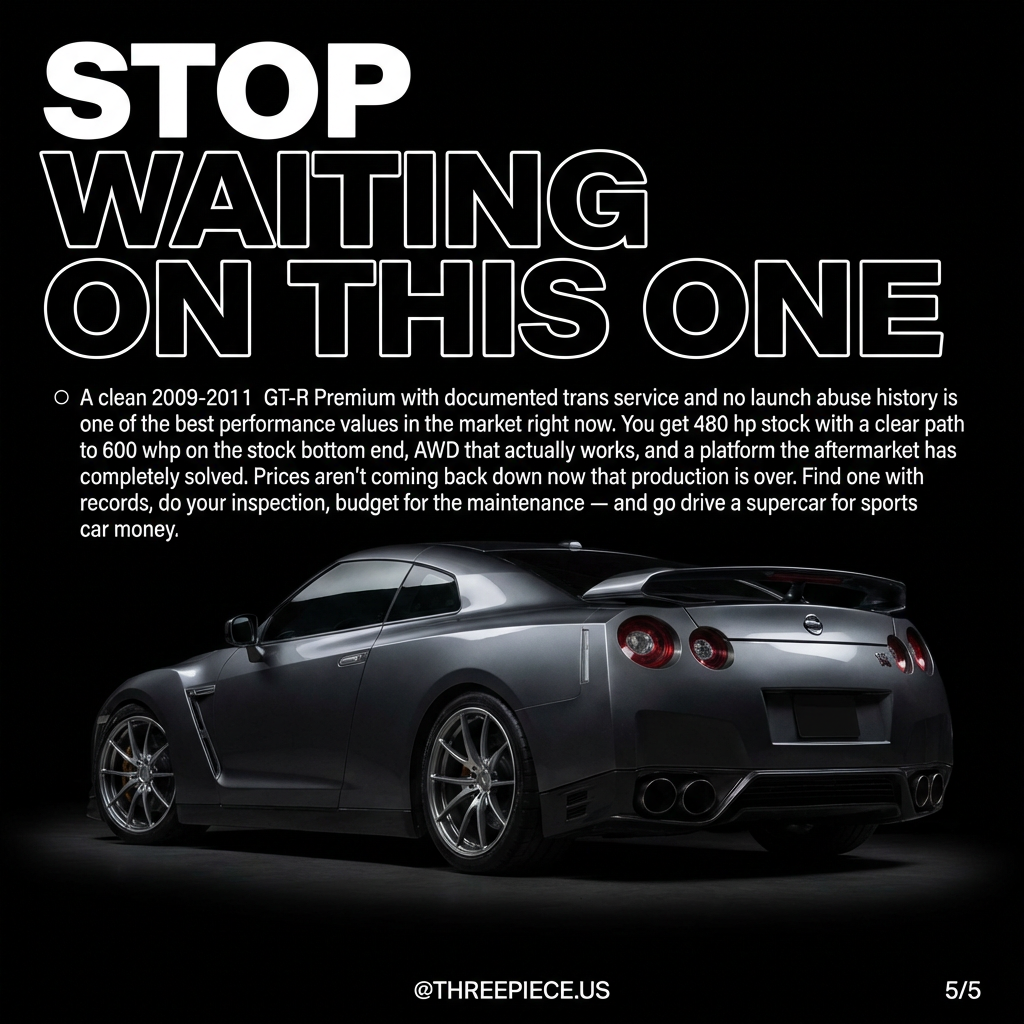
A clean 2009-2011 GT-R Premium with documented trans service and no launch abuse history is one of the best performance values in the market right now. You get 480 hp stock with a clear path to 600 whp on the stock bottom end, AWD that actually works, and a platform the aftermarket has completely solved. Prices aren't coming back down now that production is over — if anything, the Evo VIII trajectory shows what happens to Japanese performance cars once supply dries up and nostalgia kicks in.
The R35 isn't a gamble. It's a calculated buy with known failure points, documented fixes, and a community that has mapped every possible build path. Find one with records, do your inspection, budget for the maintenance, and keep the Clevite con rod bearings and DBA brake pads on your parts list. Then go drive a supercar for sports car money. Browse Nissan-specific parts and wheels to start building yours.