
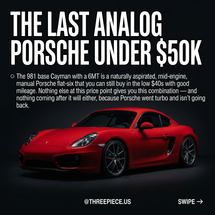
981 Cayman Base 6MT Buying Guide: Last Analog Porsche Under $50K
The 2014–2016 Porsche 981 Cayman base with a 6-speed manual is the last naturally aspirated, mid-engine, manual-transmission Porsche you can buy for under $50K — and clean examples are getting harder to find every quarter. Porsche went turbo-four with the 718, added electric-assisted steering, and filtered out most of the mechanical feedback that made the Cayman special. The 981 base 6MT is the closing chapter of an era, and in 2026, the low-$40K asking prices on well-maintained examples represent one of the strongest value propositions in the entire sports car market.
Quick links
- Why the Base Over the S or GTS
- What the 2.7 Flat-Six Actually Feels Like
- The 6MT Advantage Over PDK
- Known Failure Points and Real Costs
- Pre-Purchase Inspection Checklist
- 981 Cayman Wheel Fitment and Upgrades
- Stop Circling — Go Buy One
Why the Base Over the S or GTS
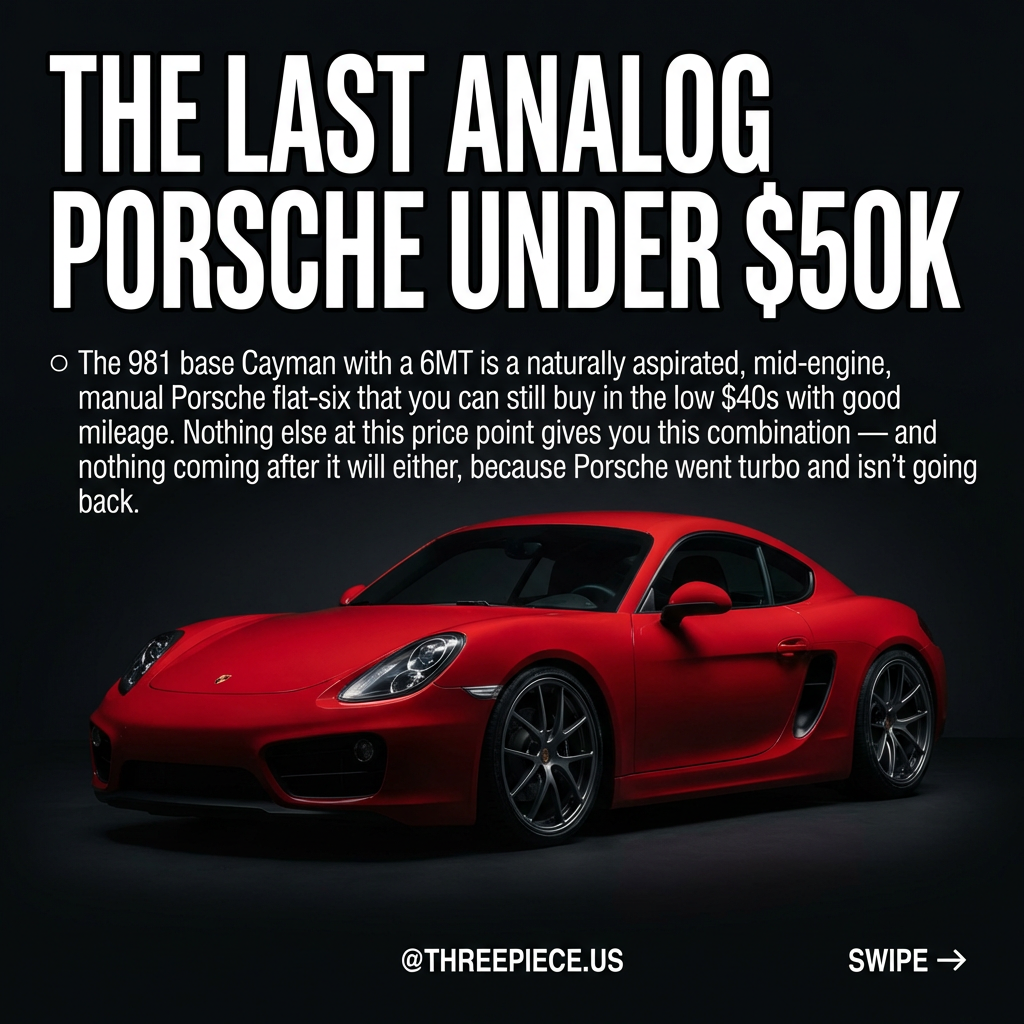
The 981 S and GTS get all the forum attention, but the base 2.7L is the overlooked sweet spot. It makes 275 hp and 211 lb-ft from a naturally aspirated flat-six — not earth-shattering on paper, but that's not the point. The 2.7 is mechanically simpler than the 3.4L in the S: fewer components under load, a less complex cooling circuit, and a track record of crossing 150,000 miles without major engine work when properly maintained. Meanwhile, the S commands a $10–15K premium on the used market, and the GTS is firmly in the $60K+ range for clean examples.
The base also sits in a pricing tier where you can actually buy the car and budget properly for maintenance, wheels, and tires without being stretched. That matters more than 40 extra horsepower you'll never use on public roads. If you're cross-shopping other analog sports cars in this bracket, our Honda S2000 CR AP2 buying guide covers another closing-window car worth comparing — but the Porsche's mid-engine balance and flat-six character are in a different league.
What the 2.7 Flat-Six Actually Feels Like
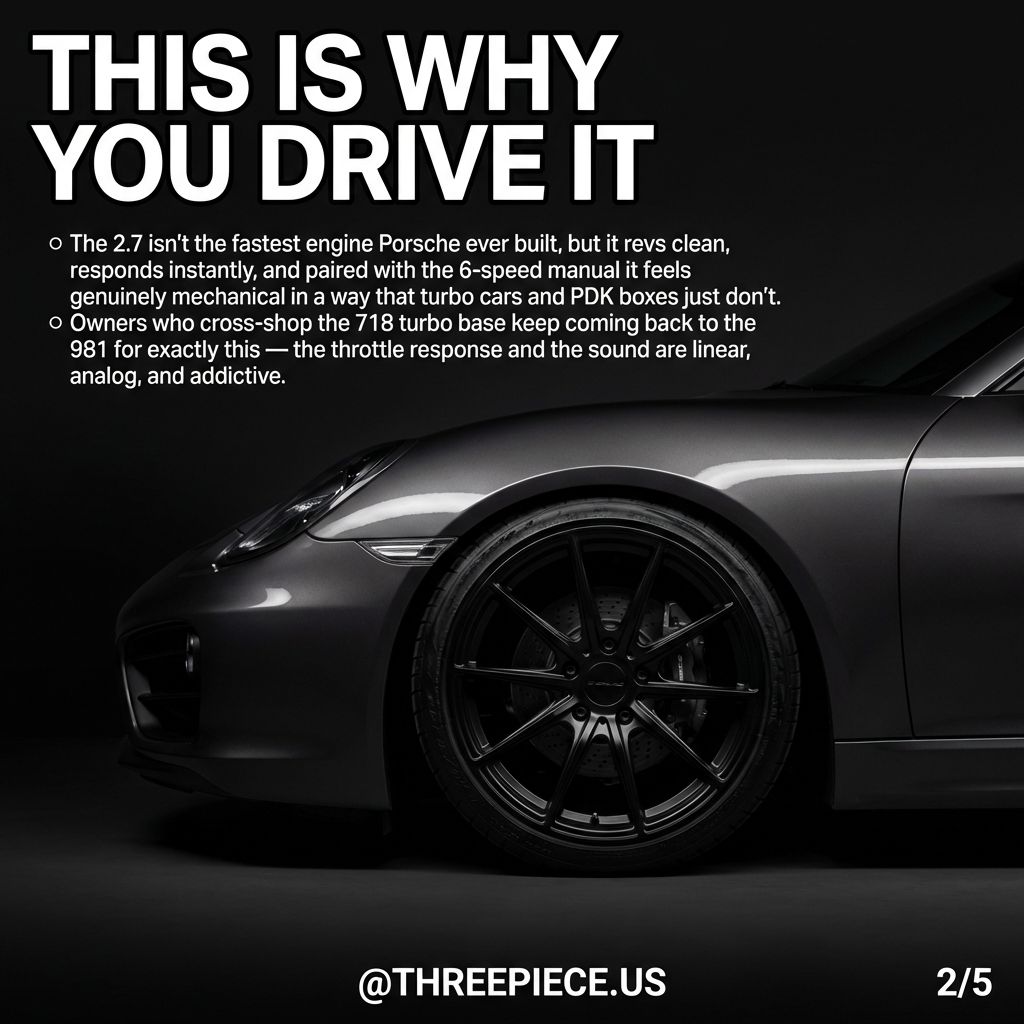
Owners who cross-shop the 718 turbo base consistently come back to the 981 for one reason: linearity. The 2.7's throttle response is instant and predictable. There's no turbo lag, no torque spike, no electronic intervention smoothing out the power delivery. You push the pedal, the engine responds, and the sound builds in a clean, linear arc that the turbo-four 718 simply cannot replicate. Paired with the 6-speed manual and hydraulic steering, the 981 base communicates through your hands and feet in a way that modern Porsches have deliberately engineered out.
This isn't nostalgia — it's a measurable difference in driver engagement. The 981's steering rack has genuine road-surface feedback. The shifter has short, mechanical throws with real gate definition. Every input you make has a proportional, unfiltered output. That's what makes the car addictive at 7/10ths on a canyon road, not just at the limit on a track. If you've read our take on the E92 M3 6MT buying guide, you'll recognize the same thesis: the cars that let you feel everything are the ones that age into classics.
The 6MT Advantage Over PDK
This is not a "manual vs. automatic" preference debate. On the 981, the 6-speed manual is the objectively smarter long-term ownership decision. Here's why:
The PDK dual-clutch transmission is a marvel of engineering — until it isn't. Position sensors inside the PDK unit fail at higher mileage, resulting in loss of reverse or odd gears. Dealer-quoted replacements run $25,000. Specialist rebuilders can sometimes restore them for $10,000–$12,000, but that's still a car-value-threatening repair on a $40K vehicle. These failures typically surface between 80,000–110,000 miles, which is exactly where most affordable 981s sit in 2026.
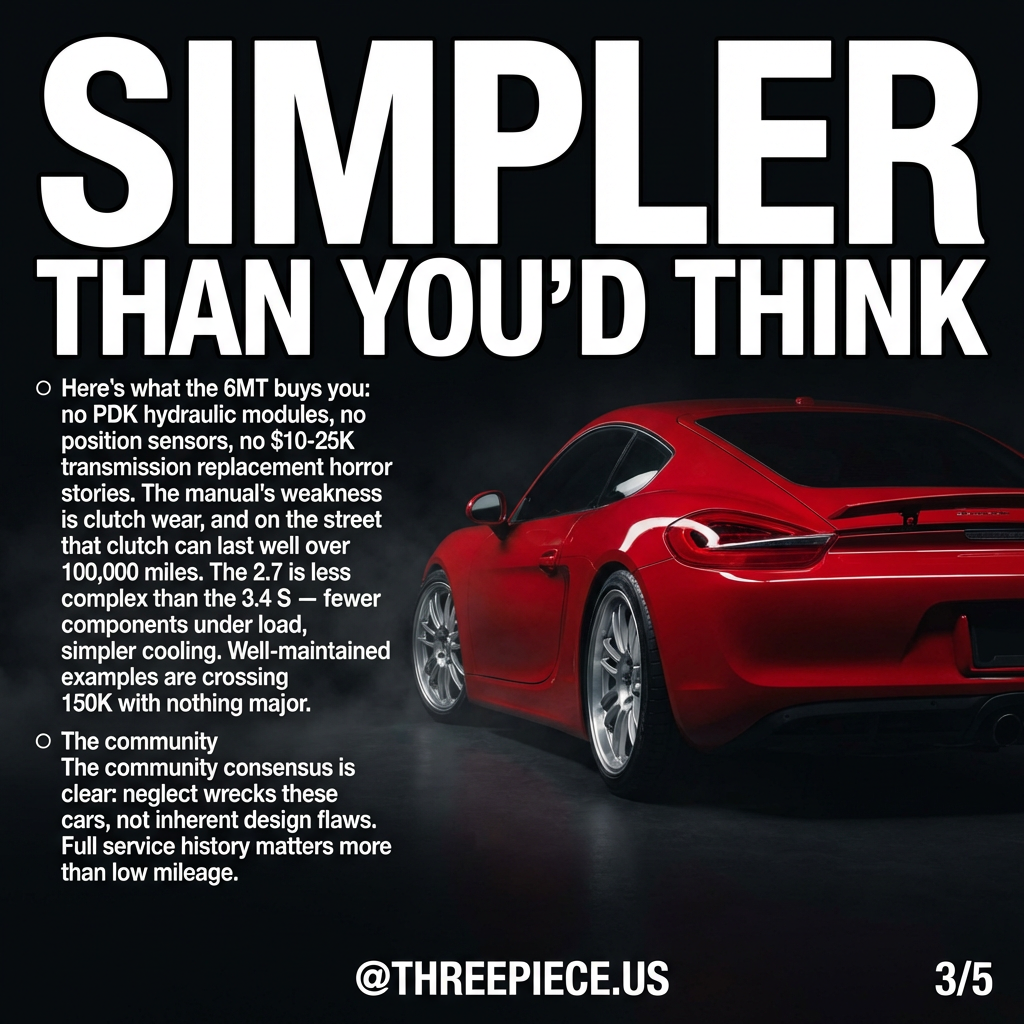
The 6MT's weakness is clutch wear — a normal consumable. On the street, a clutch can last well over 100,000 miles. When it does need replacement, a clutch and flywheel job runs $3,000–$5,000 depending on the shop. That's a fraction of PDK repair costs, and it's a known, predictable expense you can plan for. The manual also eliminates hydraulic modules, electronic actuators, and the sensor array that makes PDK repairs so expensive. Simpler drivetrain, lower long-term cost, better driver connection. The same logic applies to builds like the G37 Sport 6MT — manual transmissions are consistently the better long-term bet on performance cars.
Known Failure Points and Real Costs
The 981 base is not a money pit — but it's not a Miata either. Here's what actually breaks, when it breaks, and what it costs. These are real numbers from owner forums and independent shop invoices, not dealer estimates.
Rear Main Seal (RMS) — The most-discussed failure point. Oil leaks between the engine and transmission, visible as a wet bellhousing. On manual cars, this oil can soak the clutch disc, causing slipping and a burning smell. Typically appears after 70,000–100,000 miles. The fix requires removing the transmission, so smart owners replace the RMS and clutch together to save on labor. Budget several thousand dollars for the combined job.
Air-Oil Separator (AOS) — The internal membrane hardens or tears, allowing oil mist into the intake. Symptoms include rough idle (the infamous "boxer fart"), elevated oil consumption, and visible oil residue in the intake tract. Usually surfaces around 80,000+ miles. Parts run $400–$900, with labor at 4–8 hours depending on shop access.
High Pressure Fuel Pump (HPFP) — Presents as weak starts or no-start conditions requiring multiple cranks, often with CEL codes P1024/P1026. Common failure zone is 100,000–120,000 miles. The pump itself costs $1,500–$2,800 plus labor, and backorder issues on OEM parts are not uncommon.
VarioCam / VVT Solenoids — Rough running at low temperatures, CEL code P0084, reduced performance. Often misdiagnosed as other sensor issues. Appears around 80,000+ miles, especially with extended oil change intervals. Solenoid replacement runs $200–$800 per side plus labor for access.
Timing Chain and Guide Rails — Listen for ticking or clattering from the chain cover area on cold start. Loose guides allow chain slap, and if ignored, the chain can jump timing — that's engine-ending territory. Usually a concern past 80,000–100,000 miles. Guides and tensioner replacement is expensive but possible without a full engine tear-down. Parts and labor run several thousand dollars.
Coolant System — Plastic and rubber-metal joints in the front coolant plumbing degrade with age. Reservoirs crack, small leaks develop, and coolant loss can lead to overheating if unnoticed. This is age-related, typically 50,000–80,000 miles. Parts are inexpensive but labor is tight due to packaging.
Ignition Coils and Spark Plugs — Misfires and rough idle. Plug changes are due around 40,000–60,000 miles, but labor runs 5–7 hours because of engine access on cylinders 1 and 4. Plugs cost $200–$400 in parts; coil packs are $100–$250 each. Not catastrophic, but not cheap either.
The community consensus across Rennlist, Planet-9, and Cayman-specific forums is clear: neglect wrecks these cars, not inherent design flaws. A 981 with full service history and documented maintenance is a fundamentally different ownership experience than one with gaps in the records. If you want context on how maintenance costs compare to other performance cars in this range, our W204 C63 AMG buying guide covers a car with genuinely scary failure modes — the 981 is mild by comparison.
Pre-Purchase Inspection Checklist
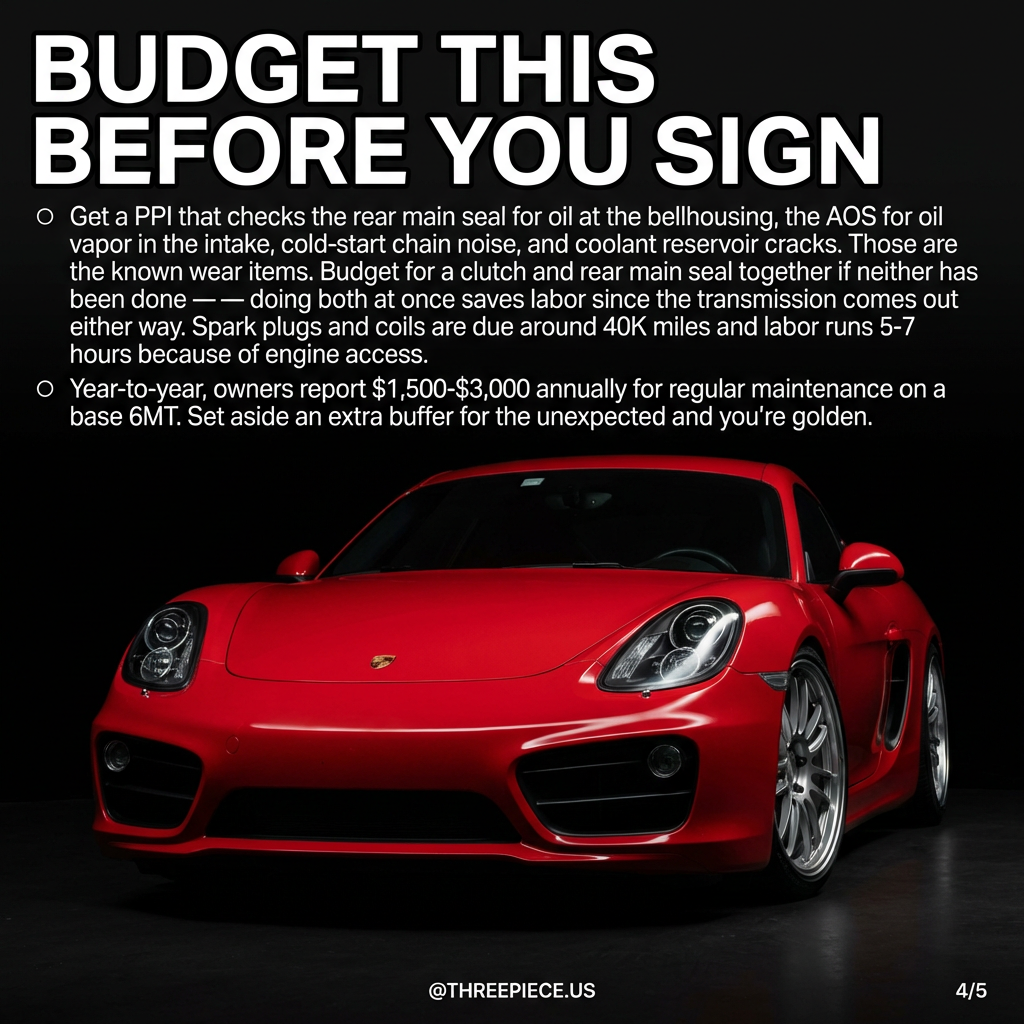
A generic PPI won't catch 981-specific issues. Make sure your inspector — ideally an independent Porsche-savvy shop, not a general mechanic — checks these items specifically:
- Rear main seal: Inspect bellhousing for oil moisture. On a manual car, check clutch disc for oil contamination.
- AOS condition: Remove the intake pipe and inspect for oil residue inside. Smell for oil vapors at idle.
- VVT solenoid codes: Full OBD scan looking for P0084 or any cam timing fault codes, even stored/cleared ones.
- HPFP behavior: Cold-start the car. If it requires multiple cranks or hesitates, the high-pressure fuel pump is suspect.
- Timing chain noise: Listen at the chain cover area during cold start. Any ticking, clattering, or metallic rattling is a red flag.
- Coolant system: Pressure test the system. Check the reservoir for cracks and the front pipes for seepage.
- Clutch feel: Drive the car in higher gears under load. Any slipping, shuddering, or burning smell means the clutch is on its way out.
- Service records: Full documentation matters more than low mileage. A 90,000-mile car with every oil change documented is a better buy than a 50,000-mile car with no records.
Annual maintenance on a base 6MT runs $1,500–$3,000 in a typical year with no major repairs. Set aside an additional buffer for the unexpected, and you're in a sustainable ownership position. For more on how maintenance budgets should factor into your build plan, our piece on whether coilovers are worth it on daily drivers covers the same philosophy — spend smart, not just fast.
981 Cayman Wheel Fitment and Upgrades
The 981 Cayman base comes from the factory on 18-inch wheels with a staggered setup: 18x8 front, 18x9.5 rear. This is a solid starting point, and the staggered configuration suits the mid-engine weight distribution perfectly. Most owners upgrading to aftermarket wheels stay at 18" or step up to 19" for a more aggressive look without sacrificing ride quality.
For 18" setups, browse 18-inch wheels in 5x130 to see what fits. If you're stepping up to 19s, check 19-inch wheels in 5x130 — the Cayman's 5x130 bolt pattern is shared with the 911, so wheel options are extensive. The Work Emotion series and Work Meister line both offer configurations that suit the 981's lines, and multi-piece wheels let you dial in the exact width and offset you need for a flush fitment without fender modification.
For tires, the factory rear size of 265/35R19 or 265/40R18 gives you a wide contact patch that complements the rear-biased weight. Pair your front wheels with 235/40R18 tires for a balanced street setup. If you're considering cast vs. forged wheels for this platform, forged is the move — the 981 is light enough that reducing unsprung mass makes a tangible difference in turn-in response and ride quality. Finish the build with proper 90-degree valve stems at $3.80 each — essential for deep-dish rear wheels where straight stems won't clear the brake caliper.
If you're running 3-piece wheels on the 981, proper hardware matters. M7x32 chrome assembly bolts at $10 each or M7x32 24K gold bolt and nut sets at $15 give you the right fastener spec with a finished look. For inspiration on how other mid-engine and rear-engine builds are running aftermarket wheels, check the ThreePiece vehicle gallery.
Stop Circling — Go Buy One
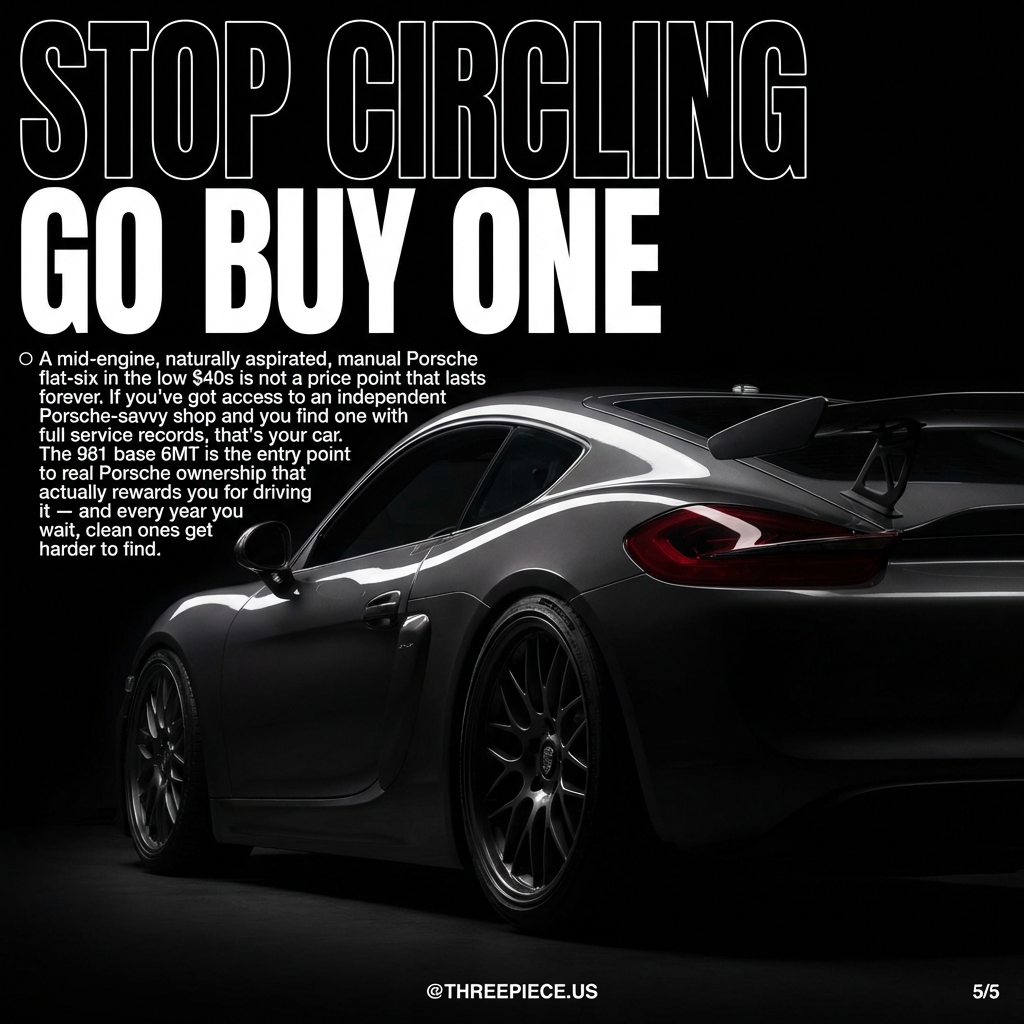
A mid-engine, naturally aspirated, manual Porsche flat-six in the low $40s is not a price point that lasts. The 981 base 6MT has been quietly appreciating as the enthusiast market realizes that Porsche isn't making anything like it anymore — and won't again. The 718's turbo-four, the electric Macan, the hybrid 911 — the direction is clear, and it's away from everything that makes the 981 special.
If you've got access to an independent Porsche shop, you find a car with full service records, and you budget properly for the known wear items, the 981 base 6MT is one of the most rewarding sports cars you can own in 2026. Every year you wait, the clean ones get scarcer and the asking prices climb. The window is still open — but it won't be for long.
When you do pull the trigger, the right set of wheels transforms the 981's stance from reserved to aggressive. Browse new wheels to find the right fit for your build, or explore Work Wheels for the full Japanese forged catalog. The 981 deserves better than stock wheels — and so do you.