Can You Run 35s on a Jeep Cherokee? (Fitment Guide)
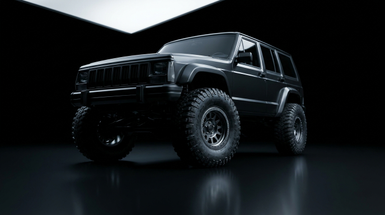
The honest bottom line: yes, you can run 35s on a Cherokee — but the KL-generation (2015-2023) is a unibody crossover with independent front suspension, not a solid-axle rock buggy, so real 35s take a proper lift, careful wheel offset, fender and pinch-weld trimming, and usually re-gearing to stay drivable. For most owners the sweet spot is a 33-inch tire; 35s are a committed build; and true 37s are a heavily modified proposition that few street-driven Cherokees should chase. Below is the straight story on what each size actually demands, where they rub, and which tire sizes fit.
Know your Cherokee before you cut anything
The KL Cherokee left the factory on a 17x7 wheel with a hefty +41 mm offset, a 5x110 bolt pattern, and a 65.1 mm hub bore. That high offset is the single most important number in this whole conversation, because it tucks the wheel deep under the strut and fender. It's great for on-road manners and ride quality, but it leaves very little room to grow a tire before it starts kissing the strut on the inside and the fender liner on the outside.
Trim matters more on this platform than almost any other detail. A Trailhawk already carries a modestly higher ride height, better approach and departure angles, tow hooks, and skid protection compared to a Latitude or Limited. That means the starting point for tire clearance isn't the same across the lineup, and a fitment that clears on one Cherokee may rub on another. Treat every claim here as a principle to verify on your specific rig, at full lock and full droop, not a guarantee.
How big can you realistically go?
Realistically, the Cherokee scales like this: a 33 is achievable with a modest lift and some trimming and is the size most owners actually live with happily; a 35 is a genuine build that involves lift, wheel spacers or lower-offset wheels, real trimming, and almost certainly a gear change; and a 37 is an outlier that demands serious fabrication, body work, and a rethink of the drivetrain. The unibody construction and IFS geometry are what set those ceilings — you don't have the fender-well volume or the axle articulation of a Wrangler, so every inch of tire is harder-won here.
Running 33s — the everyday sweet spot
If you want the biggest jump in capability for the least heartache, 33s are it. A 33x12.50R17 (or the metric-ish 285/70R17, which comes in around 32.7 inches tall) gives you noticeably more sidewall for airing down, better bite in rock and mud, and a purposeful stance — without turning the truck into a project that never leaves the garage. Expect to need a modest lift or leveling setup and some fender-liner and pinch-weld attention to clear at full lock and articulation, depending on trim and how aggressive your wheel offset is.
The trade-off with 33s is mild by comparison to the bigger sizes. You'll feel a little more steering effort and a slightly lazier throttle response, and the speedometer will read optimistically until it's corrected. But most Cherokees can carry 33s without re-gearing feeling mandatory — though it still helps. If you're stocking a garage, the 33-inch class is where the broadest, most affordable tire selection lives, from 33x12.50R17 up through 33x12.50R18 and even 33x12.50R20 for those who want to keep a larger wheel diameter.
Running 35s — the committed build
This is the size everyone asks about, so here's the real answer: 35s on a Cherokee are absolutely doable, but they are a build, not a bolt-on. A true 35x12.50R17 stands a full 35 inches tall, and clearing that in a unibody wheel well means a proper suspension lift to open up the fender gap, a lower-offset wheel or a wheel spacer to push the tire outboard and away from the strut, and meaningful trimming of the fender liners, the front fender lip, and the pinch weld. Depending on trim and lift, you may still see contact at full steering lock or under hard articulation, which is why you dial it in with the tires actually on the truck rather than trusting a spec sheet.
The offset math is where 35s live or die. Factory +41 is far too much inset for a tire this wide — you'll want to move toward the lower end of the bolt-on window this platform accepts. Wheels in the 8x17 or 8x18 range with offsets down around +25 sit within known bolt-on territory and give the wide tire somewhere to go. Just remember that pushing the wheel outboard adds leverage on the front bearings and steering components, so you're trading a little longevity for clearance. That's the deal with 35s on any IFS crossover.
Re-gearing stops being optional here for most people. A 35-inch tire dramatically changes your effective final drive, and a Cherokee's engine and transmission were calibrated for a much shorter rolling diameter. Without new gears you'll feel sluggish acceleration, constant downshifting, and a transmission that hunts on grades. If you're going to 35s, budget for the axle gearing to bring drivability back — it's the difference between a truck that tows and cruises and one that feels perpetually overwhelmed.
Running 37s — the fabrication project
Be honest with yourself about 37s. A 37x12.50R17 is 37 inches of tire trying to fit under bodywork that was never designed for it. On a Cherokee that means a tall lift, extensive body and pinch-weld work, careful attention to CV angles and driveline geometry, and aggressive re-gearing just to make the thing move with authority. Some builders have gotten there, but it's a fabrication-heavy path, and it stresses unibody structure and IFS components in ways that demand supporting modifications you don't want to skip. We do stock 37-inch sizes such as 37x12.50R17, 37x12.50R18, and 37x12.50R20, but treat that size as a specialty build rather than a weekend upgrade.
What actually changes when you go bigger
Fitting a taller, wider tire isn't one change — it's a cascade of them. Understanding each keeps you from chasing rubs and drivability gremlins after the fact.
Where they rub, and clearance
On this platform the trouble spots are predictable: the inner front fender liner and the strut on the inboard side, the front fender lip and pinch weld on the outboard side, and the rear inner arch under compression. Rubbing tends to show up not when you're driving straight but at full steering lock and when the suspension is stuffed on an obstacle. Always test through the full range of motion — turn lock to lock, cycle the suspension, and load the truck — before you call a fitment clean.
Offset and backspacing, explained properly
Offset is the distance from the wheel's mounting face to its centerline, measured in millimeters. A high positive number like the factory +41 means the mounting face sits far outboard, tucking the wheel inward under the fender. Backspacing describes the same idea from the back of the wheel: it's the distance from the mounting face to the inner lip. When you fit a wider tire, you generally want less positive offset (or a spacer) so the tire moves outboard, clearing the strut and giving the sidewall somewhere to live. Go too far and the tire pokes past the fender, throwing debris and inviting a rub on the outer lip instead. This platform accepts a range of bolt-on wheel widths and offsets — think 7.5 to 8 inches wide with offsets roughly between +25 and +42 — and the wider, lower-offset end of that window is where bigger tires belong.
Re-gearing and why it matters
Your axle gear ratio was chosen to pair the stock tire diameter with the engine's power band. A bigger tire is effectively a taller gear, so it slows acceleration, hurts throttle response, and makes the transmission shift constantly. Numerically higher axle gears restore that lost mechanical advantage, bringing back crisp acceleration, better fuel economy under load, and a transmission that stops hunting. The bigger the tire, the more this matters — mild on 33s, strongly recommended on 35s, mandatory on 37s. The exact ratio depends on your tire size, your driving mix, and your engine, so verify the right target for your build.
Speedometer and odometer correction
A taller tire covers more ground per revolution, so your speedometer reads slower than you're actually going and your odometer under-counts miles. That skews everything from your speed readout to shift points and mileage-based maintenance. Correct it with a programmer or a dealer recalibration that matches your new tire diameter — it's a small step that keeps the whole vehicle honest.
TPMS and load range
The Cherokee uses direct TPMS sensors in each wheel, so if you're buying a second set of wheels, plan for sensors and a relearn so the warning light stays off. And don't overlook load range: a Cherokee is a heavy unibody, and if you carry gear, tow, or run long highway stretches, choose a tire with an appropriate load rating for the weight you actually carry. A stiffer, higher-load-range casing resists heat and holds up better under sustained load, at the cost of a slightly firmer ride when aired up.
All-terrain or mud-terrain for a Cherokee?
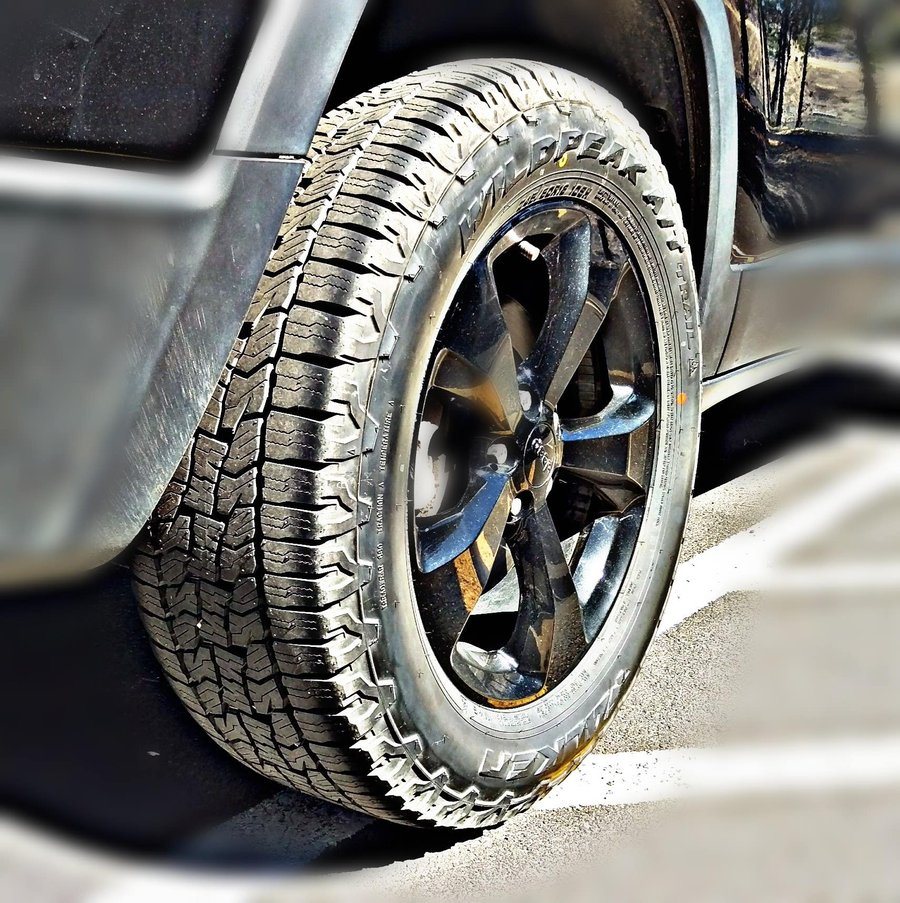
For the vast majority of Cherokees, an all-terrain is the smarter choice. A good A/T gives you strong wet and snow traction, quiet highway manners, better fuel economy, and long tread life — a match for how these trucks actually get used, which is mostly pavement with weekend trail duty. Something like the Nexen Roadian ATX in 35x12.50R18 or the versatile Nokian Outpost nAT covers that brief well.
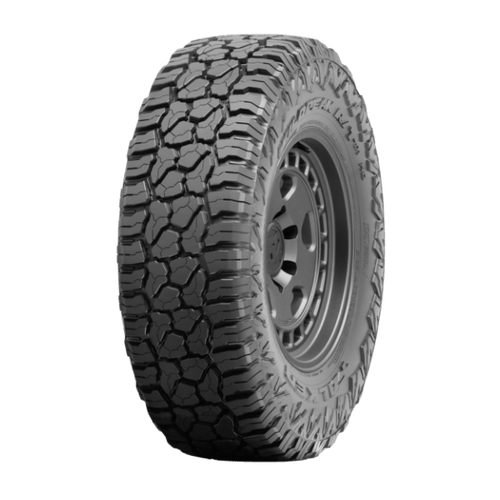
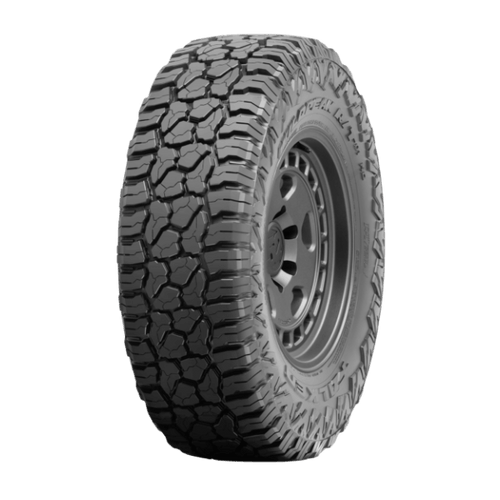
A mud-terrain earns its keep only if you spend real time in deep mud, loose rock, and sticky clay. The trade-offs are real: more road noise, faster wear, reduced ice grip, and a small economy penalty. A rugged-terrain hybrid splits the difference nicely — the Toyo Open Country R/T Pro and the Falken Wildpeak R/T01 both deliver aggressive looks and off-road bite while staying livable on the commute. Choose based on where the truck spends 80% of its time, not the 20% you brag about.
The sizes that actually fit — and what we stock
Here's the fitment picture by height. In the 33-inch class, you've got 33x12.50R17, 33x12.50R18, and 33x12.50R20 flotation sizes (all a true 33 inches tall), plus the 285/70R17 metric at about 32.7 inches for owners who want to stay closer to stock. Step up to 35s and you're looking at 35x12.50R17, 35x12.50R18, and 35x12.50R20 — all a genuine 35 inches — along with the 315/70R17 metric at roughly 34.4 inches, which behaves like a "small 35" and is often an easier fit than a full flotation 35. The 37-inch options are 37x12.50R17, 37x12.50R18, and 37x12.50R20 for committed builds.
On the 35-inch shelf we keep a genuinely useful spread. The 17-inch 35x12.50R17 is the popular choice for maximum sidewall, and we stock it across load ranges — from the lighter-duty Toyo Open Country R/T Pro to the beefier Falken Wildpeak R/T01 and the heavy-duty 12-ply Nokian Outpost nAT for owners who load their rigs. If you're keeping an 18-inch wheel, the 35x12.50R18 shelf includes the Nexen Roadian ATX, the stout Falken Wildpeak R/T01 in a 12-ply, and the Nokian Outpost nAT. Browse everything in one place on the tires hub.
What to prioritize when you buy
Start with an honest read of your trim and how you drive, then pick a target diameter — for most people, 33s deliver the best return, and 35s are worth it only if you're prepared for the lift, wheels, trimming, and gears that come with them. Next, get the wheel offset right, because the wrong offset undoes a great tire; favor the wider, lower-offset end of the bolt-on window for bigger sizes and verify brake clearance before you commit. Match load range to your real-world weight rather than the biggest number available, and budget from the outset for re-gearing and a speedometer recalibration so the finished truck drives like it should. Finally, don't skip the trial fitment: cycle the suspension and turn lock to lock before you declare victory. Do that homework and a Cherokee on 35s is a rewarding, capable rig — skip it, and you'll be chasing rubs and sluggish throttle for months.
Real Jeep Cherokee builds running 35s and up
Actual owner builds — real photos.


Frequently Asked Questions
Do I really need a lift to run 35s? Yes. A true 35-inch tire won't clear the Cherokee's fender wells at ride height, let alone under compression, without a suspension lift to open up the gap. Combine that lift with a lower-offset wheel or spacer and real trimming, and even then verify clearance at full lock and articulation on your specific truck.
Will 35s fit without re-gearing? They'll physically fit and move the truck, but they'll feel sluggish and the transmission will hunt for gears, especially on grades or while towing. A 35 is effectively a much taller final drive, so numerically higher axle gears are strongly recommended to restore acceleration, drivability, and fuel economy. The right ratio depends on your engine and driving mix.
What's the easiest big-tire upgrade for a Cherokee? A 33-inch tire, hands down. It gives you a meaningful jump in sidewall, traction, and stance with a modest lift and some trimming, and it usually keeps the truck drivable without a mandatory gear change. A 285/70R17 or a 33x12.50R17 is a great starting point for most owners.
Should I choose an all-terrain or a mud-terrain? Pick based on where the truck actually spends its time. If you're mostly on pavement with occasional trails, an all-terrain gives you quieter, longer-lasting, more economical performance. Save the mud-terrain — or a rugged-terrain hybrid — for genuine deep mud and rock work, and accept the noise, wear, and winter-grip trade-offs that come with it.
Do I need new TPMS sensors if I buy a second set of wheels? The Cherokee uses direct sensors in each wheel, so a second wheel set generally needs its own sensors and a relearn procedure to keep the dash warning off. Plan for that cost up front rather than being surprised when the light stays on after the swap.
Is the 315/70R17 easier to fit than a full 35? Often, yes. At about 34.4 inches tall it behaves like a slightly smaller 35, so it can clear with a bit less lift and trimming than a true 35x12.50 flotation tire while still giving you a big, aggressive look. It's a smart middle ground if you want most of the 35 benefit with fewer clearance headaches.
35-inch tires for the Cherokee (in stock)