Can You Run 35s on a Nissan Frontier? (Fitment Guide)
The honest bottom line: yes, you can run 35s on a Frontier — but on the current-generation truck it's a build, not a bolt-on. Expect to add a lift, dial in wheel offset and trimming, and re-gear the axles if you want the drivability back. If you want the easy, live-with-it-daily answer, a 33 is the sweet spot; 35s are absolutely doable with the right supporting mods; 37s are a full-commitment project best left to dedicated trail rigs.
Below is the real-world breakdown for the 2018–2026 Nissan Frontier, from what fits stock-ish to what it actually takes to stuff a big meat under the fenders — and which sizes we keep on the shelf so you can plan the whole package.
How big can a Frontier really go?
The Frontier rolls on a 6x114.3 bolt pattern with a 66.1 mm hub bore, and the factory wheel on these trucks is a 7x16 with roughly +30 offset. That's your starting reference point for everything that follows. From that baseline, the platform behaves like most modern mid-size body-on-frame trucks: there's meaningful room in the wheel wells, but the pinch weld along the rocker, the forward part of the front fender liner, and the sway-bar/lower control-arm area are where a taller, wider tire starts to make contact — especially at full steering lock and full compression.
Trim and generation matter more than people expect. A PRO-4X or PRO-X with its factory tuning and skid protection is set up differently than a base S or SV, and later trucks with the wider track and factory all-terrains already carry a little more tire than an entry model. None of that changes the physics — bigger tire needs more clearance — but it does change how much trimming and lift you'll need to reach the same result. Treat every number here as a planning guide and verify the final fit on your specific rig, ride height, and wheel choice.
33s: the daily-driver sweet spot
If you want the biggest visual and capability gain for the least drama, 33s are it. On the Frontier a true 33 in a flotation size like 33X12.50R17 or the metric-equivalent 285/70R17 (about 32.7 inches tall) usually fits with a modest leveling kit or small lift and light trimming — often just the front fender liner and a tweak of the crash bar or pinch weld, depending on trim and how aggressive your wheel offset is.
The trade-offs are mild. A 33 adds roughly an inch to an inch-and-a-half of radius over many factory sizes, which nudges your effective gearing taller and takes a small bite out of throttle response and fuel economy, but most owners find it livable without re-gearing. It's also the size where you can keep a wheel close to the factory 7-inch to 7.5-inch width and a sane offset, so steering feel and wheel-bearing life stay near stock. We carry 33s across the range in 17, 18, and 20-inch fitments, so you can match the look you're after.
35s: the real answer, and what they take
This is the size everyone asks about, so here's the straight talk. A genuine 35 — think 35X12.50R17, 35X12.50R18, or the taller-rim 35X12.50R20, all measuring right at 35 inches — will fit a Frontier, but it is not a leveling-kit-and-go proposition. Plan on a proper suspension lift to open up the vertical clearance, plus meaningful trimming of the front fender liners and likely the pinch weld and forward fender edges to clear at lock and on articulation. A slightly narrower metric like 315/70R17 (about 34.4 inches) is a smart half-step that reads like a 35 but shaves clearance headaches.
Wheel choice does a lot of the work here. To pull a 12.5-wide tire away from the inner fender and control arms, most 35 setups run a wider wheel with less positive offset than stock — the effect is to push the tire outward. Just know that pushing the tire out too far invites rubbing on the fender flare and rocker instead, and it changes steering geometry, so there's a window to hit rather than a single magic number. Verify offset against your lift and flare situation.
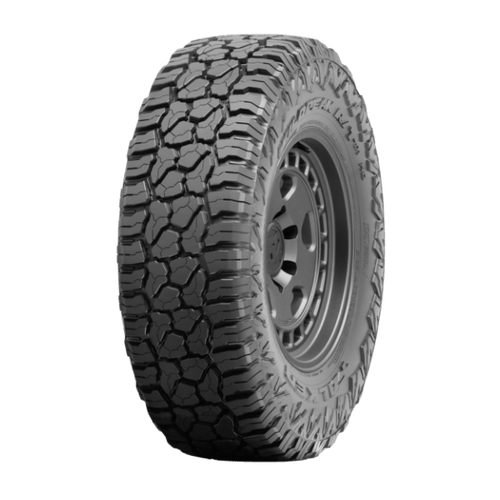
Re-gearing is the part people skip and regret. A 35 is a big jump in rolling diameter and rotating mass on a truck that wasn't geared for it from the factory, so the engine falls off its comfortable rpm range — you feel it as sluggish launches, more downshifting on grades, and a transmission that hunts. Correcting the axle gears brings the drivability and towing manners back and reduces heat and strain on the drivetrain. Whether you need it depends on how you use the truck, but for 35s it's strongly worth budgeting for. We stock a good spread of proven 35s for this platform, including the Toyo Open Country R/T Pro in 35X12.50R17, the tough Nokian Outpost nAT, and the Falken Wildpeak R/T01 in the same size, plus 18-inch options like the Nitto Recon Grappler A/T, the Nokian Outpost nAT, and the Toyo Open Country R/T Pro.
37s: the committed-build territory
Can you fit 37s on a Frontier? With enough fabrication, yes — but be honest about what that means. A true 37 (37X12.50R17, 37X12.50R18, or 37X12.50R20) demands substantial lift, aggressive body and pinch-weld trimming, careful attention to bump-stop and steering clearance, and almost certainly re-gearing — this size will noticeably degrade acceleration and braking on stock gears. Many builds at this height also touch driveline angles and may need supporting parts to keep things smooth.
None of that means it can't be done well; it means 37s are a purpose-built choice for a trail or overland rig where clearance is the priority, not a casual upgrade. If that's your goal, plan the suspension, gearing, and trimming as one package rather than bolting on tires and hoping. We keep 37s in stock for planning that kind of build, but go in with eyes open.
What actually changes when you go bigger
Where they rub, and clearance
Contact points on the Frontier follow a predictable pattern: the front fender liner and the crash-bar/pinch-weld area up front, and the inner fender or control arms if a wide tire sits too far inboard. Rubbing usually shows up at the extremes — full steering lock, full suspension compression, or both at once over a driveway lip or an off-camber trail. That's why a fit that looks perfect in the parking lot can still rub in the real world, and why trimming and offset get tuned together.
Wheel offset and backspacing, explained
Offset is the distance from the wheel's mounting face to its centerline: positive offset tucks the wheel inward toward the suspension, negative pushes it outward. Backspacing measures from the mounting face to the back lip of the wheel and is really just the same idea from a different reference. The factory Frontier wheel runs about +30 offset. Bolt-on wheel widths from 6.5 up to 7.5 inches in 16 through 20-inch diameters generally live happily in the +15 to +35 range on this truck, which keeps the tire in a sane spot. Wider 9-inch wheels and low or negative offsets are flagged for clearance and can require lift and trimming — extreme fitments especially, so check those against your setup before buying.
Re-gearing and drivability
Every inch of added tire diameter effectively raises your gearing, so the engine works harder to move the truck and spends less time in its happy rpm band. On a 33 that's a minor annoyance; on 35s and 37s it becomes real, hurting acceleration, towing, and transmission behavior while adding heat. Re-gearing the axles restores the original relationship between engine speed and road speed, and it's the single upgrade that makes a big-tire Frontier feel like a truck again rather than a boat anchor.
Speedometer, odometer, and TPMS
Taller tires travel farther per revolution, so your speedometer reads slow and your odometer under-counts miles unless you recalibrate. Some trucks handle this with a programmer or a dealer/tuner recalibration keyed to the new diameter — get it corrected so your speed, mileage, and any speed-based safety systems stay honest. If your rig runs TPMS, plan to transfer or add sensors to new wheels and have them relearned so the system works correctly.
Load range on a heavy rig
The Frontier is a heavy truck, and if you tow or carry gear the tire's load range matters. Many of the burlier options for this platform come in stouter load ratings — you'll see ratings from lighter-duty flotation tires up through the heavier 12-ply-equivalent constructions in the 35 lineup. Match the load range to how you actually load the truck; a heavier-rated casing resists punctures and sidewall flex off-road but rides firmer, so it's a balance.
All-terrain vs mud-terrain for this truck
For a Frontier that mostly commutes, road-trips, and sees gravel, forest roads, and the occasional trail, a quality all-terrain is the right call: quieter, better in rain and snow, longer-wearing, and easier on fuel. If your truck lives in mud, rock, and deep sand and pavement is just the drive to the trailhead, a mud-terrain or a rugged-terrain hybrid earns its keep with bigger voids and tougher sidewalls. Hybrid R/T designs like the Toyo R/T Pro and Falken Wildpeak R/T split the difference nicely for a truck that has to do both. Choose based on your honest mix of miles, not the look — you can browse the full range across all tires to compare tread styles side by side.
The sizes that fit, and how to buy smart
Here's the practical menu by height. For 33s: 33X12.50R17, 33X12.50R18, and 33X12.50R20 all measure 33 inches, with 285/70R17 as a slightly shorter 32.7-inch metric alternative. For 35s: 35X12.50R17, 35X12.50R18, and 35X12.50R20 at a true 35 inches, with 315/70R17 at about 34.4 inches as the easier-fitting half-step. For 37s: 37X12.50R17, 37X12.50R18, and 37X12.50R20.
When you buy, prioritize in this order: pick the diameter that matches your appetite for supporting mods (be realistic), then choose rim size for ride and looks — a 17 gives you more sidewall for airing down off-road, while 18s and 20s look sharper on the street. Next, match the offset to your lift and flare plan so the tire sits where it should. Then select tread type and load range for how you drive and load the truck. Buying the tires, wheels, lift, and gears as one coordinated plan almost always turns out better than chasing them piecemeal.
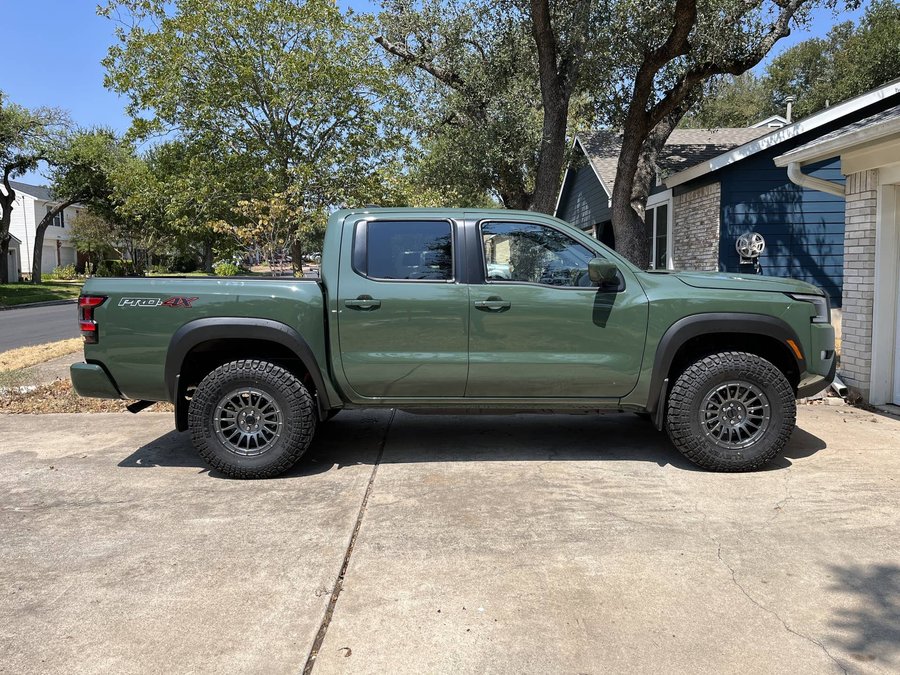
Real Nissan Frontier builds running 35s and up
Actual owner builds — real photos.


Frequently Asked Questions
Do I absolutely need a lift to run 35s on a Frontier?
Practically speaking, yes. A true 35 needs vertical clearance that a leveling kit alone won't provide without heavy rubbing, so plan on a proper suspension lift plus trimming. The exact height depends on your trim, wheel offset, and how much trimming you're willing to do, so verify the combination for your rig rather than assuming a single number works for everyone.
Will 35s hurt my gas mileage and acceleration?
Some, yes. Bigger, heavier tires raise your effective gearing and add rotating mass, which softens throttle response and can trim fuel economy — the effect grows with tire size. Re-gearing the axles restores much of the lost drivability and is strongly recommended for 35s and essentially required for 37s.
What's the easiest size that still looks aggressive?
A 33 is the sweet spot for most Frontier owners: it delivers a real stance and capability bump with only modest lift and trimming, and many people run it without re-gearing. If you want the presence of a 35 with fewer clearance battles, a 315/70R17 at roughly 34.4 inches is a great middle ground.
What offset should I run with bigger tires?
Factory is around +30, and bolt-on wheel widths on this truck generally stay happy in the +15 to +35 range. Wider wheels with lower offset push the tire outward to clear the suspension but can rub the flares and change steering feel, so there's a window to hit. Confirm the offset against your specific lift and fender setup before ordering.
Do I need to worry about TPMS and my speedometer?
Yes on both. Taller tires make the speedometer read slow and the odometer under-count, so recalibrate to keep your speed and mileage accurate. If your truck uses TPMS, plan to move or add sensors to the new wheels and have them relearned so the system functions properly.
All-terrain or mud-terrain — which should I choose?
Base it on your real driving mix. If you spend most miles on pavement and mild trails, an all-terrain rides quieter, wears longer, and handles rain and snow better. If mud, rock, and sand dominate, a mud-terrain or rugged hybrid gives you the bite and sidewall toughness you need, at the cost of some road noise and mileage.
35-inch tires for the Frontier (in stock)