
Can You Run 35s on a Jeep Gladiator? (Fitment Guide)
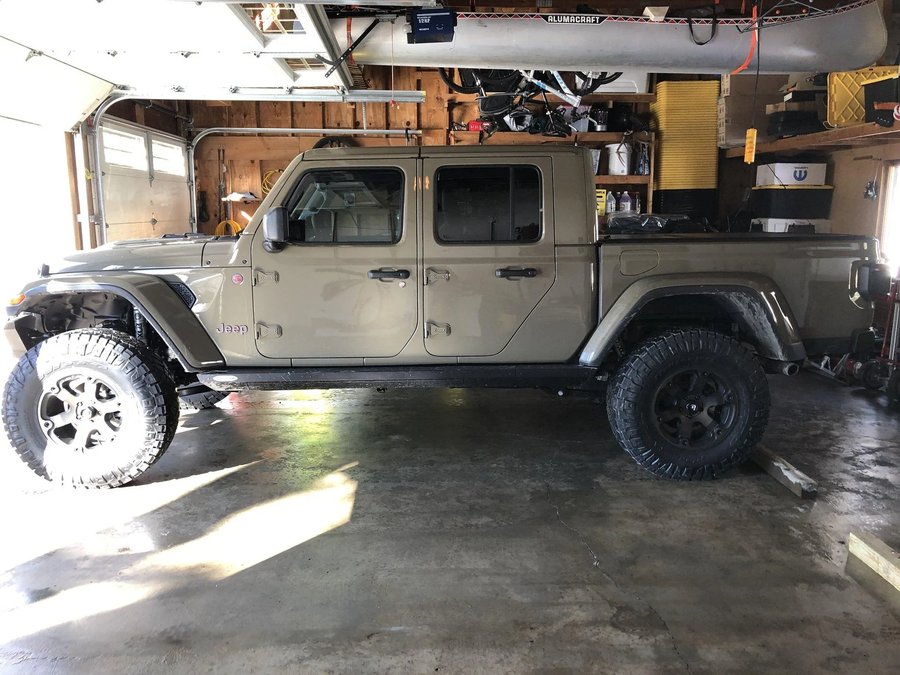
Short answer: yes, a Jeep Gladiator can run 35s — and it's one of the most natural upgrades you can make to this truck. A Rubicon on its stock suspension is close to swallowing a 35 with only minor trimming and the right wheel offset, while a Sport or Overland typically wants a modest lift and a re-gear to make 35s live comfortably day to day. Below is the honest 33/35/37-inch breakdown, what the offset and lift actually take, the exact sizes that fit, and where the trade-offs hide.
The Gladiator (JT) is a fascinating platform for tire fitment because it wears a truck bed on a Wrangler-derived front end. That long wheelbase and heavier rear payload change the math a little compared to a JL, but the fundamentals are the same: generous fender openings, solid axles front and rear, and a factory geometry that leaves real room to grow. Let's get into what that means for your rig.
How Big You Can Realistically Go
From the factory, the Gladiator ships on a 17x7.5 wheel with a fairly high +44mm offset and a 5x127 bolt pattern (2020–2026). That high offset tucks the tire inboard toward the spring perches, which is great for stock geometry but starts to work against you the moment you go wider — the tire's shoulder moves closer to the frame and control arms. That single fact drives almost every fitment decision on this truck.
Practically speaking, the ceiling depends heavily on trim and how far you're willing to modify. A Rubicon rolls off the line with taller factory suspension, better fender clearance, and stronger axles, so it flirts with 35s out of the box. A Sport, Overland, or Mojave will each behave a little differently — the Mojave's desert-tuned suspension sits differently than a standard Sport, so verify clearance for your specific rig rather than assuming. As a general rule, expect 33s to be nearly plug-and-play, 35s to be the sweet spot with a small lift and possible trimming, and 37s to be a committed build. You can browse the full range on our tire hub once you've settled on a target diameter.
The 33-Inch Route: The Easy Win
Thirty-threes are the low-drama upgrade for the Gladiator. On most trims you can bolt on a 33 with little more than a leveling spacer or a small lift, and many Rubicons take them with essentially no fuss. The appeal is that 33s barely disturb the factory drivetrain math — the diameter change is small enough that the truck still feels stock-quick off the line, your fuel economy hit is minimal, and in many cases you can live with the original gearing.
In real numbers, a genuine 33 like the 33X12.50R17 flotation size measures right at 33.0 inches of overall diameter, and we also stock it in 33X12.50R18 and 33X12.50R20 for larger-wheel builds. If you prefer a metric size that rides a touch more like the factory rubber, a 285/70R17 comes in at about 32.7 inches — technically just under a true 33 but close enough that most people call it one. This is the tier where you can genuinely keep things simple.
The 35-Inch Sweet Spot
This is where most Gladiator owners land, and for good reason: 35s fill the fenders, add real ground clearance and approach angle, and still keep the truck civil on-road. The honest version is that a Rubicon can often get very close to 35s with only minor pinch-weld trimming and attention to wheel offset, while non-Rubicon trims generally want a modest suspension lift to keep the tire off the fender liner and away from the front lower control arm mount at full stuff and full lock.
The two places a 35 tends to rub on this platform are the front of the wheel well (the fender liner and pinch seam) at full steering lock, and the rear at full compression if your backspacing is aggressive. A wheel with a lower offset — moving the tire outboard — solves the inner rub but adds strain to wheel bearings and can bring the tread closer to the flare. It's a balancing act, and the exact result depends on your lift height, control arms, and how much trimming you're willing to do, so verify the combination for your rig before committing.
The good news is the size is well supported. A true 35 like the 35X12.50R17 measures 35.0 inches overall, and we carry it alongside 35X12.50R18 and 35X12.50R20. If you lean metric, a 315/70R17 runs about 34.4 inches — a hair shorter, slightly narrower, and a nice compromise for someone who wants most of the 35 look with a bit less rub risk. On the tread side, our in-stock 17-inch 35s include the aggressive hybrid Toyo Open Country R/T Pro in a Load Range E and a lighter Load Range C version of the same tire, plus the heavy-duty Nokian Outpost nAT in Load Range F. On 18s, the Nexen Roadian ATX, the Nokian Outpost nAT, and the Toyo R/T Pro are all in stock.
The 37-Inch Build: Committed Territory
Thirty-sevens transform a Gladiator, but they're a build rather than a bolt-on. On this platform 37s essentially always demand a proper lift, and depending on setup you may be looking at more aggressive fender trimming, extended bump stops, and geometry corrections like a front track bar and control arm adjustments to keep the truck driving straight. The long JT wheelbase actually helps stability with big meats, but the extra rotating mass and diameter magnify every drivetrain compromise.
The two biggest realities of 37s are gearing and stress. A 37 adds enough diameter over stock that most owners re-gear the axles to restore acceleration, towing grunt, and transmission behavior — more on that below. You'll also want to think hard about the truck's weight; a loaded Gladiator with a camper shell and gear is a heavy vehicle, and a 37 puts leverage on the axles, U-joints, and ball joints. We stock true 37s in 37X12.50R17, 37X12.50R18, and 37X12.50R20, all measuring right at 37.0 inches. If your goal is 37s, plan the suspension and gearing first and the tire last.
What Actually Changes When You Go Bigger
Where Tires Rub and How Clearance Works
Rub on a Gladiator shows up in two states: at full steering lock (the leading edge of the tire meets the fender liner and pinch seam) and at full suspension compression (the tire crowds the flare or inner wheel well). A lift addresses the vertical clearance; offset and trimming address the horizontal and turning clearance. Because the factory offset is high, a very negative-offset wheel that pushes the tire way outboard can look great but tends to require body modification — the extreme low- and negative-offset combinations we see on wide 20s and 22s are flagged as needing a lift or bodywork for exactly that reason.
Offset and Backspacing, Explained Properly
Offset is the distance from the wheel's mounting face to its centerline, in millimeters. Positive offset (like the factory +44) pulls the wheel inboard; lower or negative offset pushes it outboard. Backspacing measures the same idea differently — from the mounting face to the inner lip of the wheel, in inches — and it's what determines how close your tire's inner shoulder sits to the frame and suspension. On the Gladiator, a common move when fitting wider tires is dropping to a lower offset (around +5 to +18 on a 17- or 18-inch wheel) so the tire clears the inner components. Our bolt-on wheel examples span from that +5 range up to the factory +44 across 17", 18", 19", and 20" diameters, which gives you room to dial the stance. Go too far outboard, though, and you increase the leverage on the wheel bearings and steering, and you may need flares or trimming — so treat offset as a clearance tool, not just a look.
Re-Gearing and Why It Matters
Bigger tires are effectively taller gearing — they make each engine revolution cover more ground, which dulls acceleration, hurts low-end torque, and forces the transmission to hunt for the right ratio. Going from stock diameter to a 35, and especially a 37, can noticeably sap drivability. Re-gearing the axles (fitting numerically higher ratios) restores that lost mechanical advantage, brings the powerband back where you want it, and takes strain off the transmission and torque converter. The right ratio depends on your engine, transmission, tire diameter, and how you drive — towing and rock-crawling reward more aggressive gears than a highway commuter — so treat the exact number as something to spec for your rig rather than a universal figure.
Speedometer, Odometer, TPMS, and Load Range
A taller tire makes the speedometer read slow and the odometer accumulate miles too gently, which also throws off shift points and cruise behavior. Plan on a speed-calibration device or a dealer/tuner recalibration when you change diameter meaningfully. The Gladiator uses TPMS sensors, so make sure your new wheels are sensor-compatible and get them programmed — otherwise you'll live with a dash light. Finally, respect load range: a Gladiator, especially one hauling gear or a shell, is heavy, and a heavier-duty carcass resists sidewall flex and heat. That's why we carry the same 35 in multiple load ranges — a Load Range C tire rides softer and airs down nicely for trails, while E and F options carry more weight and shrug off highway heat under load. Match the rating to how you actually use the truck.
All-Terrain vs. Mud-Terrain for the Gladiator
For a truck that splits its life between commuting, overlanding, and the occasional trail, an all-terrain is usually the smart default: quieter, better in rain and snow, longer-wearing, and easier on fuel. A mud-terrain earns its keep if you spend real time in deep mud, loose rock, and technical terrain where the big open tread blocks clear themselves and bite. The compromise is noise, tread life, and a bit of wet-road nervousness. A modern hybrid — like the R/T Pro pattern we stock in several 35 sizes — splits the difference, giving you meaningful off-road bite without the full mud-tire drone. Choose based on the percentage of your driving that's actually off pavement, and be honest about it.
What to Prioritize as a Buyer
Start with the diameter that matches your goals and your appetite for modification: 33s for simplicity, 35s for the best all-around balance on this platform, 37s for a dedicated build. Then choose wheel diameter and offset to get the clearance and stance you want — a 17" wheel gives you more sidewall to air down, while 18s and 20s look modern but ride firmer. Next, pick load range honestly for your truck's weight and use. Only then choose tread pattern. And budget for the supporting cast: a lift where needed, speedometer calibration, TPMS programming, and re-gearing if you're going to 37s or want your 35s to feel right. Browse everything on the tire hub and cross-check the exact size against your setup before you buy.
Real Jeep Gladiator builds running 35s and up
Actual owner builds — real photos.


Frequently Asked Questions
Can a stock Gladiator run 35s with no lift?
A Rubicon can get close, often needing only minor pinch-weld trimming and a sensible wheel offset because it starts with taller factory suspension and more fender clearance. Non-Rubicon trims generally want a modest lift to keep a 35 from rubbing the liner at full lock and full compression. Because trims, lift heights, and offsets all interact, verify the specific combination for your rig before assuming it will clear.
Do I have to re-gear for 35s on a Gladiator?
You don't strictly have to, but many owners find 35s dull the acceleration and make the transmission work harder, especially when towing or loaded. Re-gearing restores the lost mechanical advantage and brings the powerband back to where it feels stock. Whether it's worth it depends on your engine, how you drive, and how much you tow — it's more clearly worthwhile on 37s than on 35s.
What wheel offset works best for bigger tires on the JT?
The factory offset is a high +44mm, which tucks the tire inboard. When fitting wider rubber, many builds drop to a lower offset — commonly in the +5 to +18 range on 17" and 18" wheels — to move the tire outboard and clear the frame and suspension. Going too far negative pushes the tire past the flare and adds strain to bearings, so use offset as a clearance tool and confirm it against your lift and trimming.
17, 18, or 20-inch wheels for a Gladiator on 35s?
Seventeen-inch wheels give you the most sidewall, which helps ride quality and airing down for the trail, and they're the enthusiast favorite. Eighteens are a solid middle ground, and 20s deliver a modern on-road look but ride firmer and offer less sidewall to flex. We carry true 35s across 17", 18", and 20" diameters, so the choice comes down to how much trail time you expect versus street manners.
Will bigger tires mess up my speedometer and TPMS?
Yes on both fronts, but both are easily managed. A taller tire makes the speedometer read low and affects shift behavior, so plan on a calibration device or dealer/tuner correction. TPMS sensors need to be present and programmed in your new wheels, or you'll see a persistent dash warning — factor sensor compatibility into your wheel choice.
Which load range should I choose for a Gladiator?
It depends on weight and use. A Load Range C tire rides softer and airs down beautifully for trail work, while E and F options carry more weight and handle highway heat better under a loaded, shell-equipped truck. Because the Gladiator is heavy, match the rating to your real-world payload — we stock the same 35 tread in multiple load ranges precisely so you can make that call.
35-inch tires for the Gladiator (in stock)


