
Posted by THREEPIECE.US on Mar 20th 2026
Are Big Brake Kits Overrated? Reality Check on $4K BBK Hype
Most enthusiasts spending $4,000+ on big brake kits would see better lap times from a tire upgrade. The BBK industry sells the dream of "track-ready stopping power" but here's the reality: your stock brakes can probably lock up your wheels just fine. The limiting factor isn't your calipers — it's your tires' grip and brake cooling.
Quick links
- Why the BBK Hype Exists
- The Performance Reality
- What Actually Improves Stopping
- When BBKs Actually Make Sense
- Better Brake Upgrades for Your Money
Why the BBK Hype Exists
Brembo and AP Racing logos sell the dream. Everyone wants that track look with massive 380mm+ rotors and multi-piston calipers. The marketing claims are compelling: bigger rotors dissipate heat better, reducing fade on repeated hard stops. Larger pistons spread clamping force more evenly, theoretically improving modulation and pedal feel.
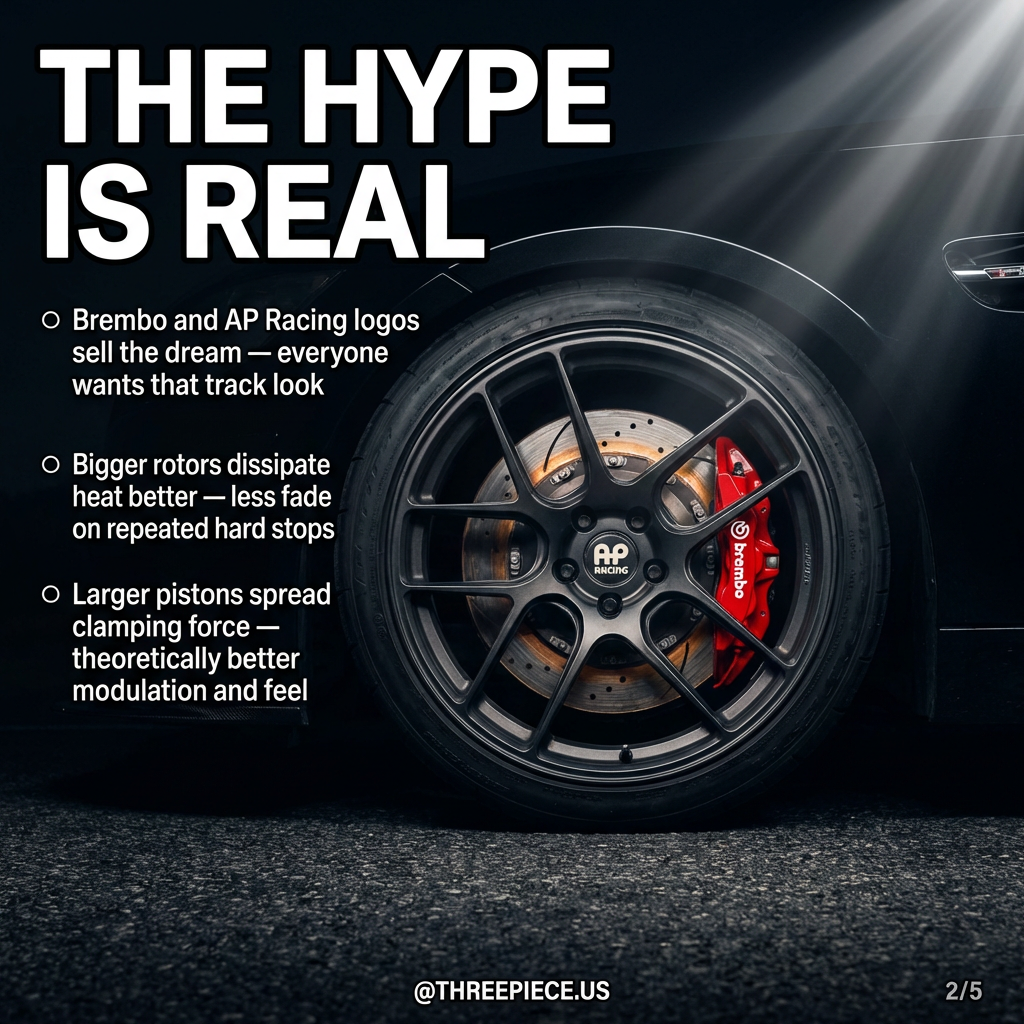
The visual impact is undeniable. A 6-piston Brembo setup fills out wheel wells that looked empty with stock brakes. It's the same psychology that drives wheel upgrades — bigger looks more serious. But unlike wheels, where larger diameter can improve handling, brake size follows different physics.
Check out our E46 M3 fitment guide to see how brake clearance affects wheel sizing choices on serious track builds.
The Performance Reality
More rotating mass kills acceleration. Those 15-20lb lightweight wheels become 25-30lb anchors with oversized rotors. Pad compounds matter more than rotor size — Hawk DTC-70s on stock rotors will outbrake most BBKs with street pads.
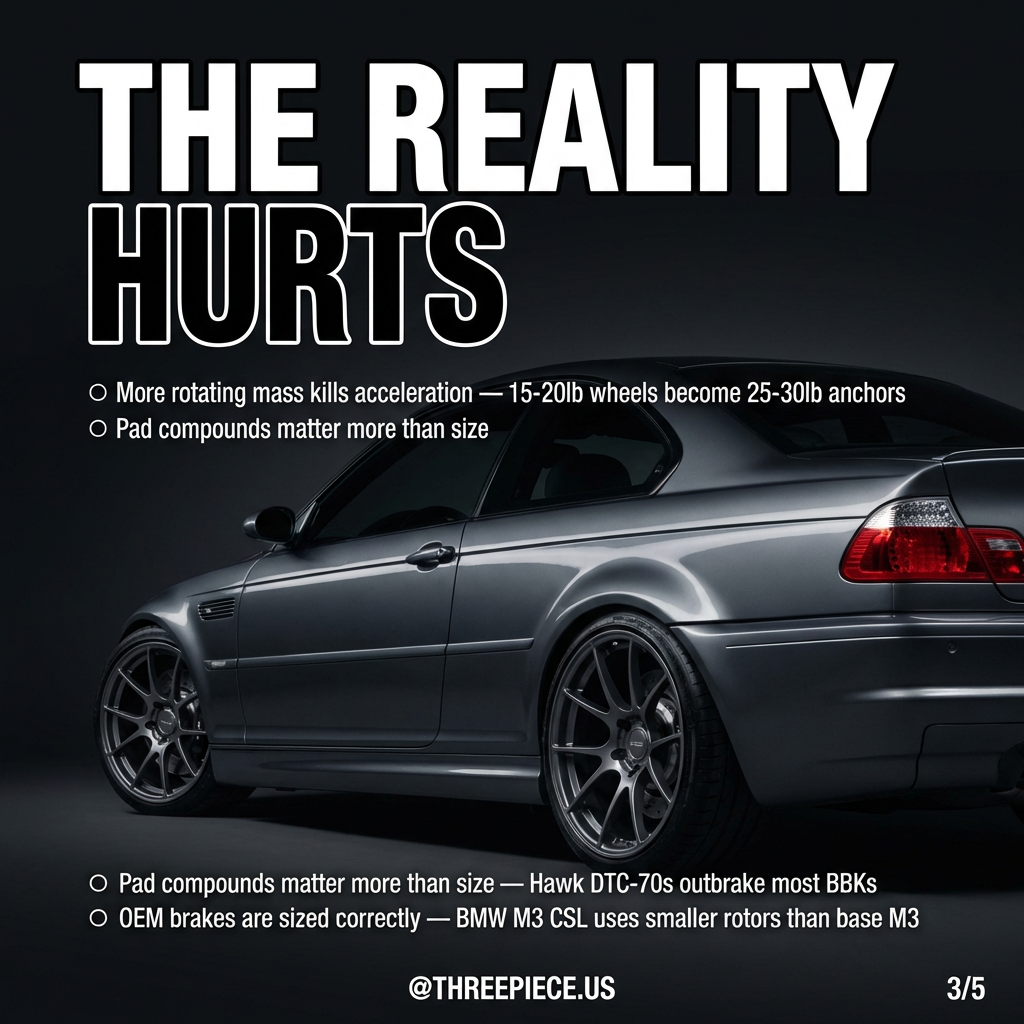
OEM engineers aren't idiots. The BMW M3 CSL uses smaller rotors than the base M3 because weight reduction trumped theoretical heat capacity. Ferrari's track-focused models prioritize rotor weight over size. If you're not consistently hitting brake temperatures above 1200°F, you don't need more thermal mass.
The Function and Form E46 M3 coilover kit shows how serious track builds prioritize suspension over brake size. Weight reduction and handling balance matter more than rotor diameter for most drivers.
What Actually Improves Stopping
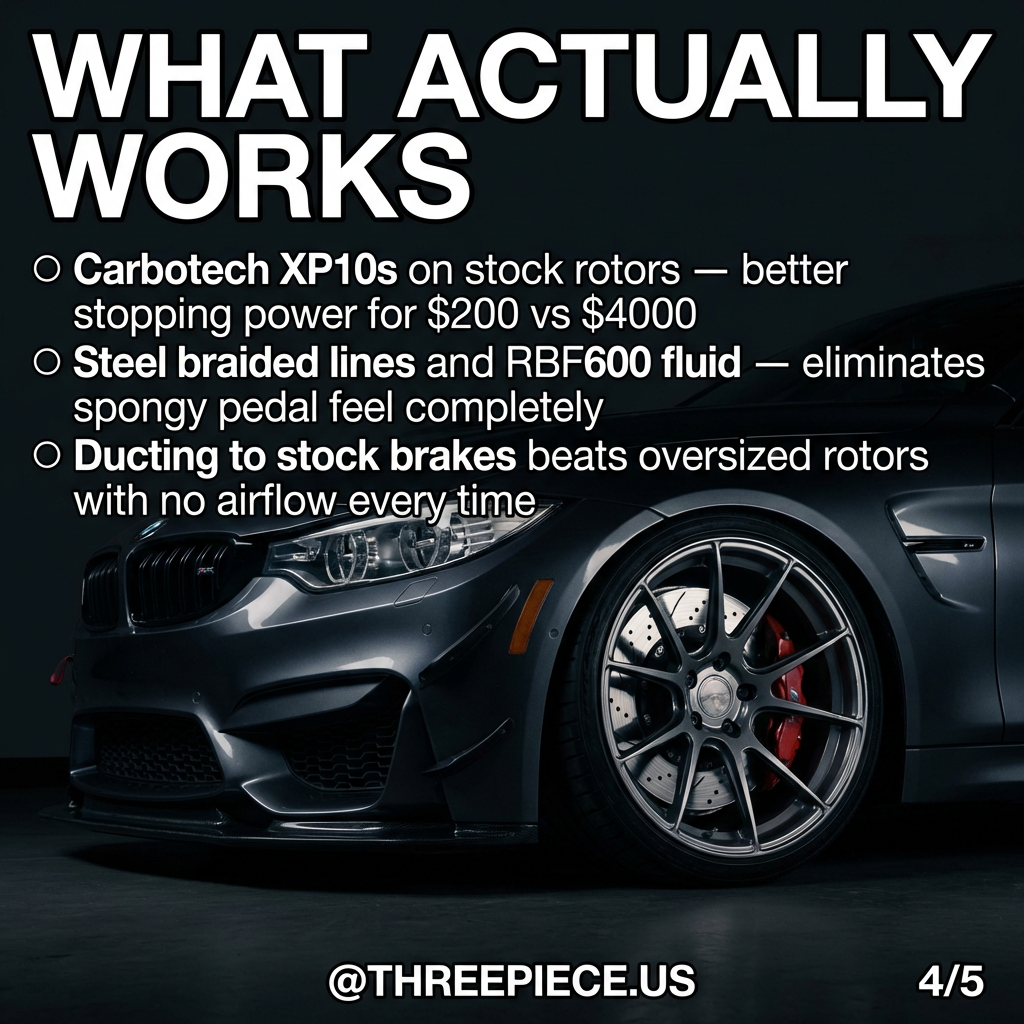
Carbotech XP10s on stock rotors deliver better stopping power for $200 versus $4,000 for a full BBK. Steel braided lines and RBF600 fluid eliminate spongy pedal feel completely. Ducting to stock brakes beats oversized rotors with no airflow every time.
The hierarchy of brake improvements that actually matter:
- Tires first — Michelin Pilot Sport Cup 2s will transform braking more than any rotor
- Pads second — Track compounds like Carbotech XP10 or Pagid RS29
- Fluid third — Motul RBF600 or Castrol SRF for consistent pedal feel
- Lines fourth — Stainless steel eliminates expansion under pressure
- Ducting fifth — Cool air to stock rotors beats hot air to big rotors
Our coilover spring rate guide explains why suspension setup affects braking performance more than rotor size for most applications.
When BBKs Actually Make Sense
You're running 15+ minute sessions at Laguna Seca or Road America with consistent 1200°F+ brake temperatures. Your car makes 600+ horsepower and weighs 4000+ pounds — physics demands bigger rotors for repeated stops from 150+ mph.
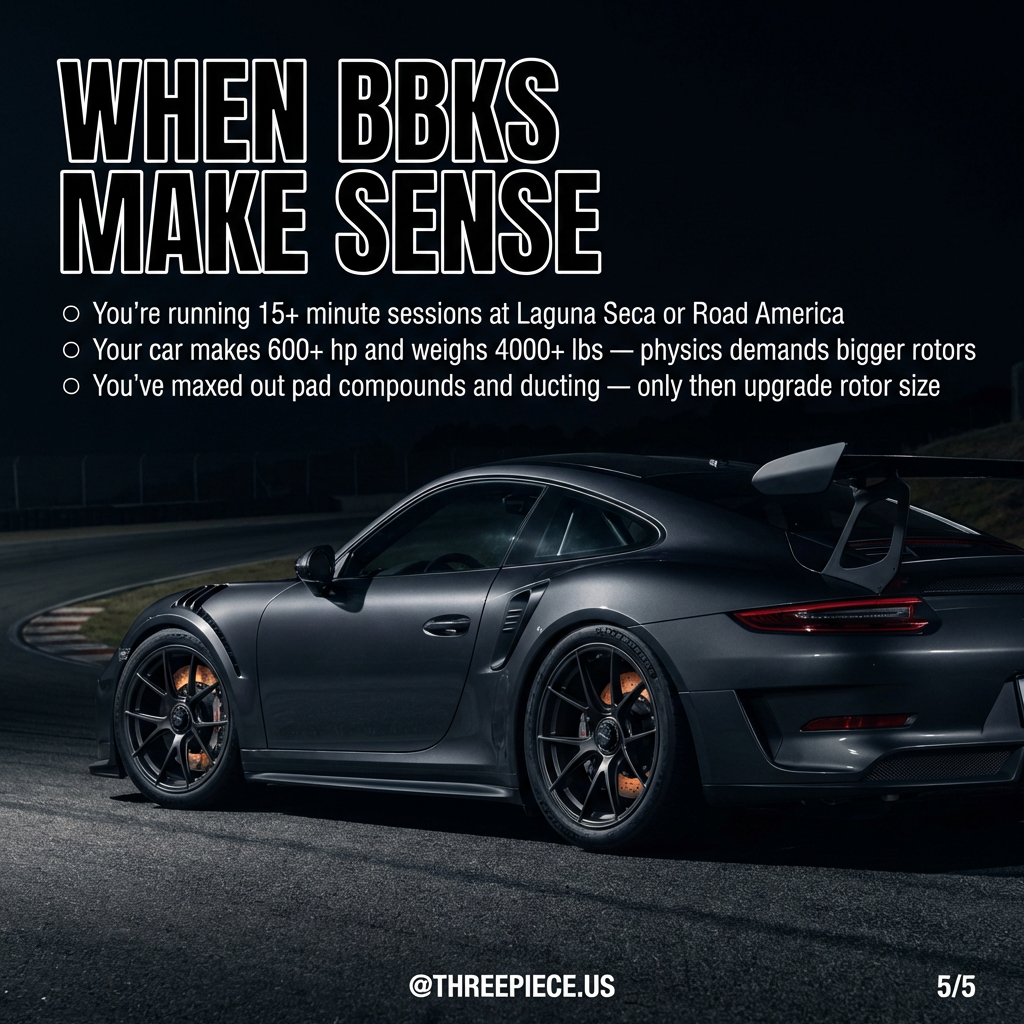
You've maxed out pad compounds and ducting — only then upgrade rotor size. The Alcon Ford Raptor Gen 3 BBK at $3,211 makes sense for a 6,000-pound truck doing desert racing. The EBC Racing BRZ/GT86 BBK at $1,980 is questionable for a 2,800-pound car with 200 horsepower.
Real track drivers know that consistent lap times come from driver skill and setup, not rotor diameter. Read our E46 M3 buying guide to understand why stock brakes handle serious track duty when properly maintained.
Better Brake Upgrades for Your Money
Instead of a $4,000 BBK, spend $1,500 on track tires, $300 on race pads, $200 on fluid and lines, and $500 on brake ducting. You'll have better stopping performance and $1,500 left over for suspension or driver training.
The Kartboy Subaru brake adapters at $273 let you run larger rotors without the weight penalty of full calipers. Smart upgrade for Subaru owners who actually need more thermal capacity.
Check our vehicle gallery to see how serious builders prioritize upgrades. Most track-focused builds run stock brake sizes with upgraded compounds and cooling. Browse our wheel accessories section for proper 90-degree valve stems at $3.80 and Work VS center caps at $50 that complement a balanced build approach.
Most BBK buyers would get better lap times from a tire upgrade. Save your money for modifications that actually make you faster — like driver training, proper suspension setup, and quality rubber that can actually use the stopping power your stock brakes already provide.