

8th Gen Civic Wheel Fitment Guide: Daily, Track & Stance
It’s about time your 8th gen gets some aftermarket wheels. Realistically, it probably already has some…Just about every 8th gen has a set at this point. But if you’re here, either the previous owner had poor taste or completely botched the fit–we’re going to fix that.
We’re going to show some of our favorite aftermarket wheels for this platform, designs that look good and specs that go with them. There’s something for everyone, whether you’re looking for entry-level wheels that will be easy on the wallet, or something higher-end; also, all types of fitment: from daily-driver, track, or even show/stance.
Quick links
- Basic fitment info
- Big brake considerations
- 8th gen daily driver fitment
- 8th gen track fitment
- 8th gen stance fitment
Basic fitment info
- Lug pattern: 5x114.3
- Lug thread: M12x1.5
- Center bore: 64.1
- Lug torque: 80ft/lbs
The 8th gen marks the great leap to 5x114.3 from the classic 4x100 found on the older models. Of course, with any change, the community hated it at first, but it turned out to be a pretty good thing because of how many new options were available.
We have over 130K options for 5x114.3 PCD.
While these will bolt up, only a handful of them are going to look right. Keep reading, and we’ll help whittle down the search based on diameter, width, offset, and also, what tires to pair with them.
Brake upgrades

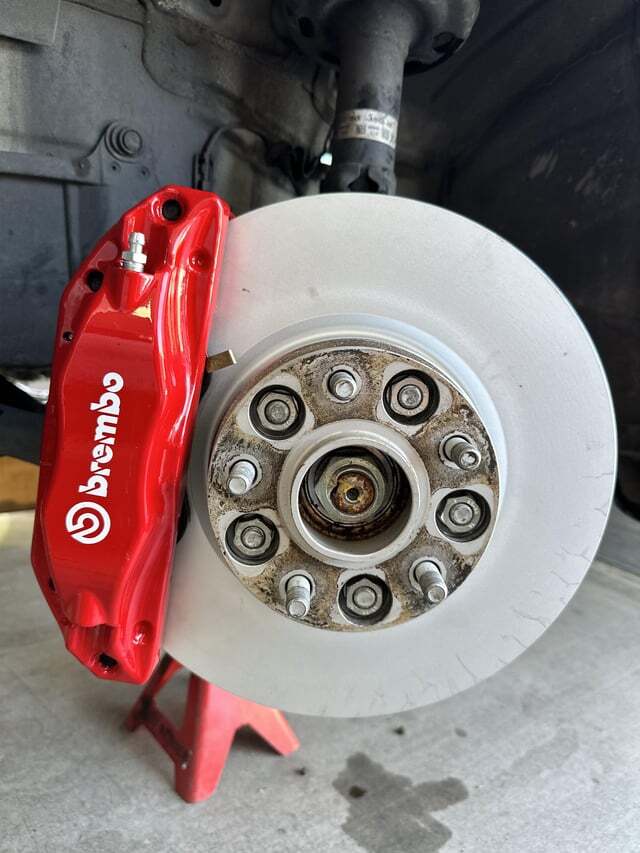
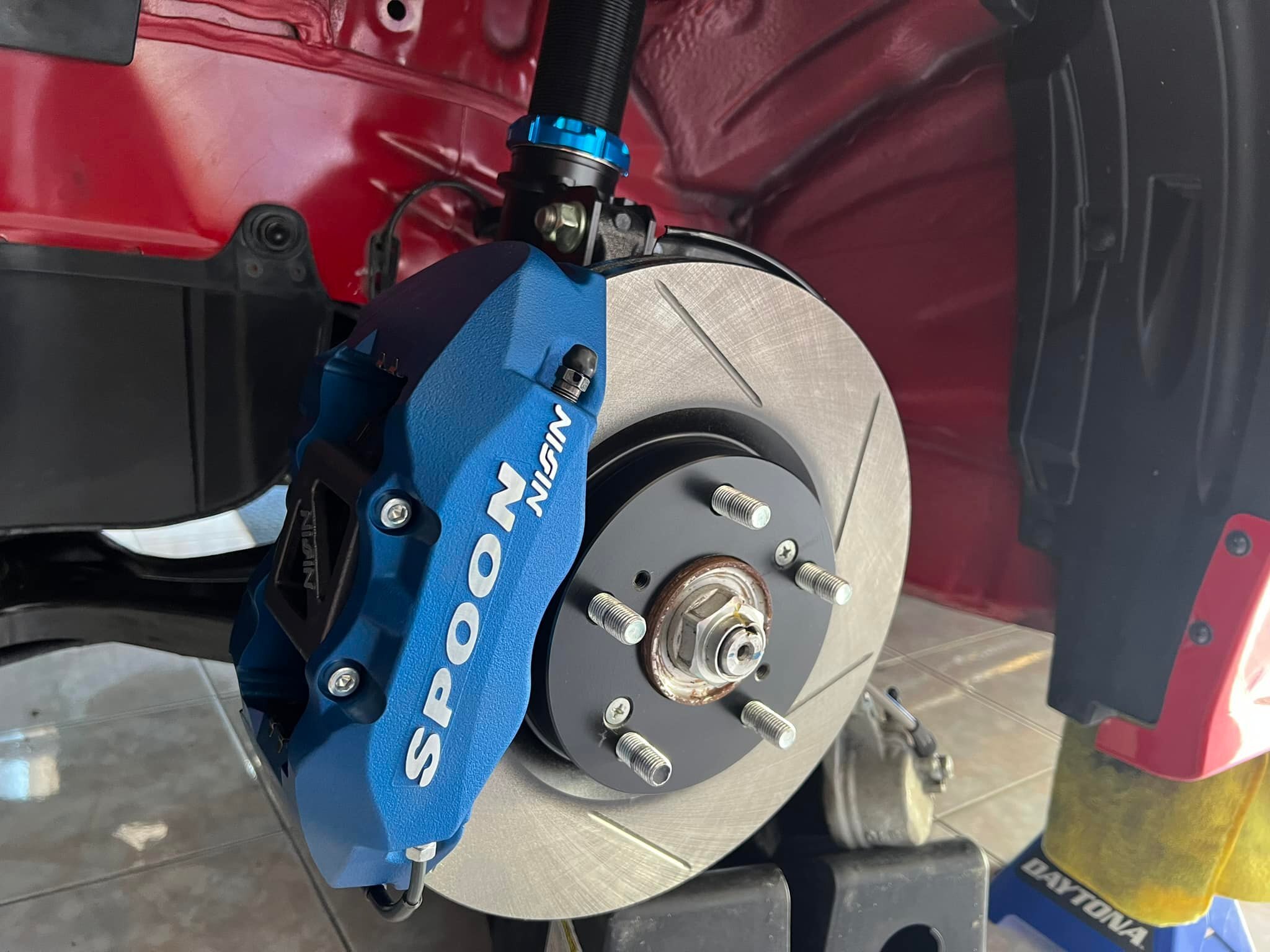
We’ll talk about specs soon, but first, a few notes about brake upgrades and how they affect clearance. The most popular upgrades are retrofitted from other models.
TSX brakes
TSX rotors are 300mm (11.8”), the same as the SI. The main difference is a larger caliper. Any 17” wheels and a lot of 16’s fit over these. Unless you’re looking for a winter setup, 17 is kinda the minimum for the 8th gen anyway.
While TSX calipers are a little larger, they normally won’t cause clearance issues.
TL-S brakes
TL Type-S brakes use even larger calipers (Brembo) and rotors (310mm). A lot of 17” wheels will fit over these, but not all. Anything with a step lip and flat face will be harder to fit, especially multi-piece wheels.
Some rims will fit over the calipers, but will need a small spacer to clear the spokes, depending on factors like wheel disk type. TSX calipers are less sexy, they also don't stick out as much as the TL-S Brembos, so take that into account if you plan on upgrading brakes in the future.
Aftermarket brake kits
There’s also a bunch of aftermarket options. Spoon brakes appear to be more or less the same as stock (uses factory SI rotors; mostly for looks), while certain BBKs are massive and will almost definitely need 18’s.
With aftermarket brakes, the manufacturer should be able to advise you on what wheels fit.
8th gen Civic aftermarket wheels
Daily driver & street car setups
This is for those who want more aggressive fitment and better performance, but don’t want to go crazy with body mods or run hovercraft-camber. We always advocate for rolling fenders because it’s cheap assurance, but depending on ride height, some of these might not need it.

|
Fitment Facts |
||
|
|
Front |
Rear |
|
Wheels |
||
|
Tires |
Goodyear Eagle 225/45R17 |
Goodyear Eagle 225/45R17 |
|
Notes |
Stock suspension No fender work |
|
It was hard to find an 8th gen on stock suspension, but that’s what this FA5 has… and it doesn’t look half bad.
These tires are slightly stretched, which helps them clear with unrolled fenders. Either wider tires or lower ride height might warrant some fender rolling, but as-is, this car has 0 rubbing issues.

|
Fitment Facts |
||
|
|
Front |
Rear |
|
Wheels |
||
|
Tires |
||
|
Notes |
H&R lowering springs |
|
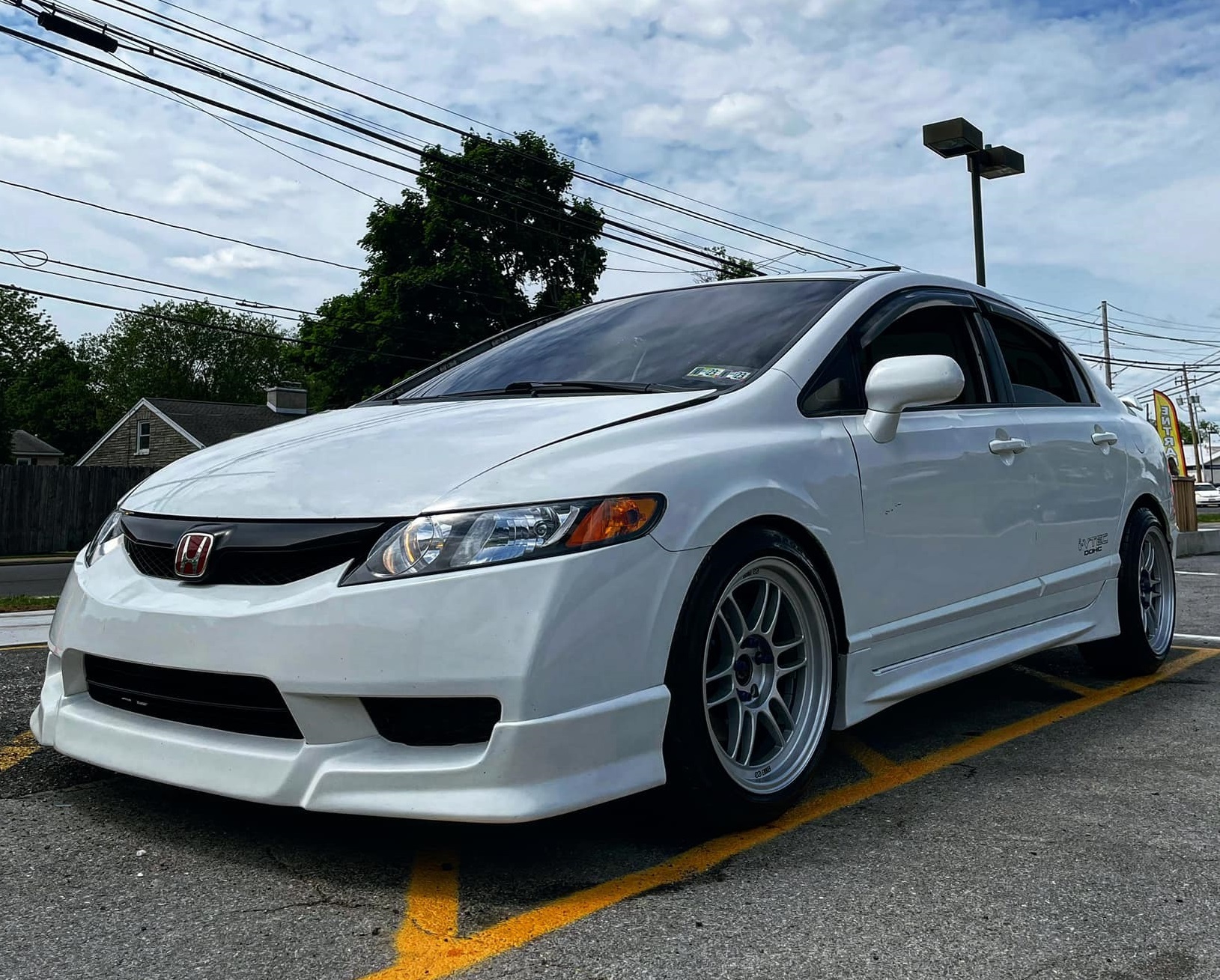
17’s are the most popular size, but 18’s can work too. Here’s another Si sedan, but on 18’s.
The fitment is a little less aggressive considering the higher offset and narrower wheels. With these 40 aspect ratio tires, the overall rolling diameter works out to about the same.
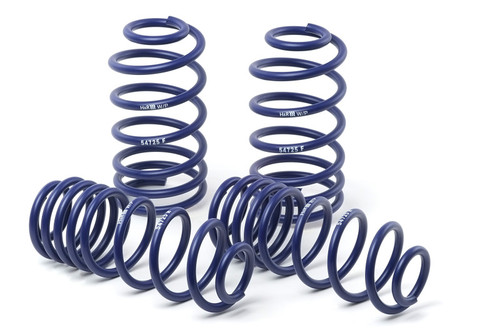
This car is on H&R lowering springs, but still doesn’t rub. No modification was needed to the fenders.

|
Fitment Facts |
||
|
|
Front |
Rear |
|
Wheels |
||
|
Tires |
||
|
Notes |
Fenders rolled Front camber bolts |
|
Going up to a 235 tire will usually need fender rolling. This car has the fenders rolled all around, but not pulled. It has a bit of extra camber, but it’s still completely practical.
For the first time, we see coilovers, although the ride height is similar to stock.

This build would definitely work well on track given the parts that were used, but in the next section we’ll look at even 245+ wide tires.


Aggressive street & track fitment
These setups maximize tire contact patch and are best for cars that need the extra grip. 17's are perfered for weight savings.
As we go up in tire width, fender rolling is a must. Some of these even require a bit of pulling and or trimming.

|
Fitment Facts |
||
|
|
Front |
Rear |
|
Wheels |
Konig Hypergram 17x9 +40 (effective +35) |
|
|
Tires |
||
|
Notes |
5mm spacer in the front Fenders rolled Some rubbing |
|
These exact wheel specs have already been shown. So what’s the difference? This one has 245/40 tires. Everything we found at this size required fender rolling. Even with fenders rolled, this car still rubs, but not excessively.
This car also has a 5mm front spacer and about -2 degrees of camber all around.

|
Fitment Facts |
||
|
|
Front |
Rear |
|
Wheels |
||
|
Tires |
||
|
Notes |
Rolled & pulled fenders |
|
This FG1 is running a very similar setup to the last, just with lower offset wheels.
The fenders are rolled and slightly pulled to avoid rubbing.
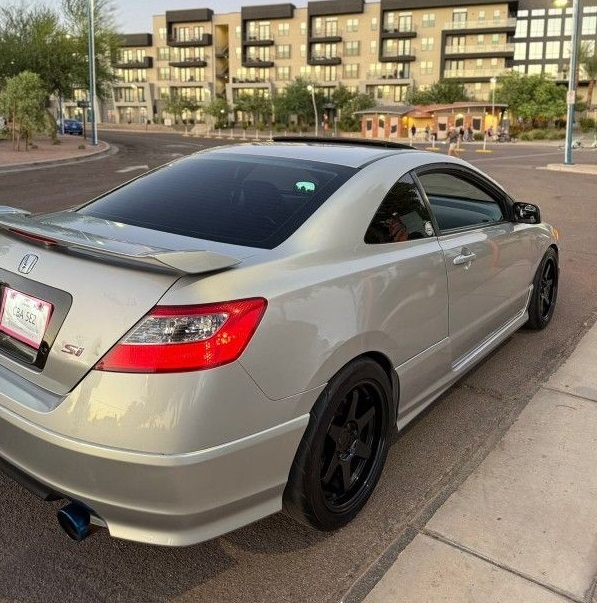

|
Fitment Facts |
||
|
|
Front |
Rear |
|
Wheels |
Gram Lights 57DR 17x9.0 +38 (effective +30) |
Gram Lights 57DR 17x9.0 +38 (effective +33) |
|
Tires |
||
|
Notes |
Wheels clear TL-S caliper w/ 8mm spacers Fenders rolled and pulled Coilovers |
|
255 tires are the largest size you can comfortably fit on stock bodywork.
This car is running 255/40R17. The wheels are also spaced out to +30 front // +33 rear (front spacers needed to clear TL-S calipers). The result is an aggressive setup that needed the fenders rolled & pulled.
As we can see, there’s also a good amount of camber: about -3 all around.
There’s still a bit of rubbing, but it should be possible to have 0 rubbing with a higher ride height.
Stance fitment
Our final section has a few examples of stance fitment–form>function. Here you’ll see stretched tires, lots of camber, and undoubtedly some fender work.

|
Fitment Facts |
||
|
|
Front |
Rear |
|
Wheels |
Work Emotion CR-Kai 17x9 +28 (effective +23) |
|
|
Tires |
||
|
Notes |
Fenders rolled and trimmed Rev9 Hyper2 coilovers Pair of camber bolts in front -4 degees front / -2.5 rear |
|
This Si sedan is running ‘reverse staggered’ fitment. We did a guide on all types of staggered setups, but to sum it up: reverse staggered means the front wheels will be wider than the rear.
On this car, 17x9 was used in the front and 17x8 in the rear.
The front camber is more than ideal, but that’s what was needed to fit lower offset wheels (plus a 5mm spacer). The fenders are rolled, and according to the owner, ‘trimmed’–there looks to be a bit of pull too.
Coilovers are from Rev9, rear camber arms from SPC, and it has front camber bolts. All in all, no rubbing.

|
Fitment Facts |
||
|
|
Front |
Rear |
|
Wheels |
||
|
Tires |
||
|
Notes |
2 SPC Camber Bolts in each front coilover |
|
Here’s some aggressive static fitment, if that’s your style. This FA5 is riding on Truhart coilovers. To dial in the alignment, it's got Truhart rear camber arms and 2x camber bolts per coil (both bolts in the lower mount are cammed).

The fenders are rolled and pulled, and still, this car rubs, but that comes with the territory.

|
Fitment Facts |
||
|
|
Front |
Rear |
|
Wheels |
Shuriken Airtekk Forged 18x10 +20 (effective +9) |
Shuriken Airtekk Forged 18x10.5 +20 (effective +9) |
|
Tires |
||
|
Notes |
Truhart air suspension kit See more here |
|
If you want stance fitment, but don’t want to rip your fenders off, how about air? This R18 FG1 is on an air suspension kit from Truhart. We saw reverse staggered, but this is a normal staggered setup with 18x10 +20 fronts and 18x10.5 +20 rears. 11mm spacers make these specs absolutely ridiculous for a stock-bodied Civic.

How did he do it? As we see, lots of camber and also, the tires are 215/40 on 10 and 10.5 wheels–that’s a gnarly stretch. When aired up, there’s 0 rubbing.
Obviously, with fitment like this, the fenders will have to be rolled and pulled. Adjustable rear arms are a must, and you’ll need camber bolts in the front to get this much angle.
This one comes from our gallery. If you want your own car featured, be sure to add it once you get your fitment dialed in.
Wrap up
The specs that people run on these cars are all over the place. On one hand, you might see something as mild as 17x8.5 +45, on the other, you might see stance setups running 10”+ wide wheels.
Really, it comes down to how you’re going to use your car. Here’s a recap:
If your car is used as a daily and you just want to change the look, go for something like a 17x8.5 +40 with 225/40 tires. Maybe 18” wheels if you want something different.
Want more aggressive fitment? Maybe a track setup? Drop the offset down a bit and increase the tire size. 17x9 +35 with 245 or 255 tires.
For a stanced show car, drop the offset down even more and go for 9.5” or wider wheels with stretched tires. Really, with enough camber and stretch, the sky is the limit.