

Posted by THREEPIECE.US on Apr 5th 2026
EPA Engine Swap Rules 2025: Why Your LS Swap Is Now Illegal
The EPA just made most engine swaps technically illegal, and the enforcement is ramping up faster than most builders realize. New interpretations of existing Clean Air Act regulations now classify any engine swap that removes original emissions equipment as a federal violation — even if your swapped engine is cleaner than what you pulled out. This isn't about new laws; it's about how they're reading the old ones, and it could kill the heart of car culture if we don't understand what's actually happening.

Quick links
- What Actually Changed
- Who's Getting Hit
- The Real Financial Impact
- What Builders Need to Do Now
- The Future of Engine Swaps
What Actually Changed
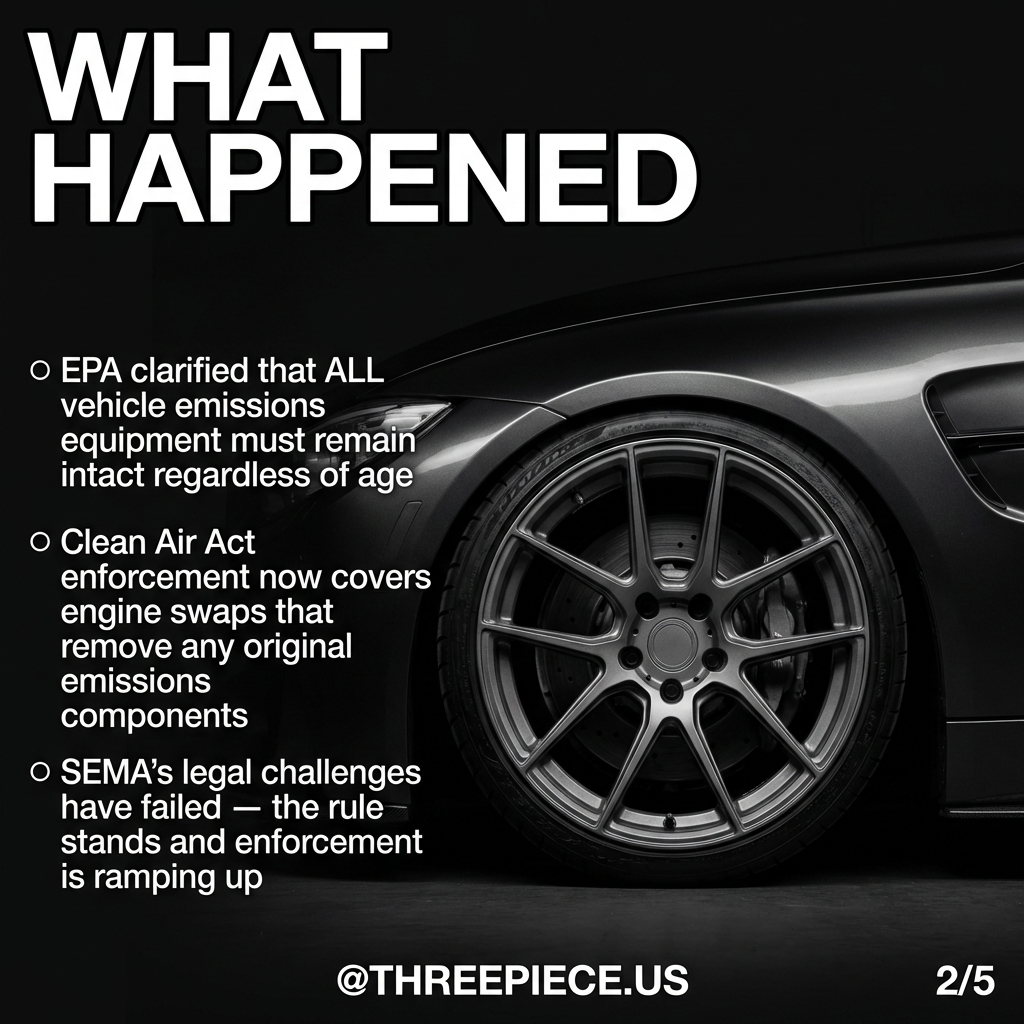
The EPA clarified that ALL vehicle emissions equipment must remain intact regardless of the vehicle's age. This means your 1985 Camaro with an LS swap needs to retain every emissions component from both the donor and recipient vehicles. The Clean Air Act enforcement now covers engine swaps that remove any original emissions components, and SEMA's legal challenges have failed — the rule stands and enforcement is ramping up.
This isn't about emissions testing in your state. Federal law supersedes state regulations, meaning even states without emissions testing can still see federal enforcement. The key issue is that most swaps involve removing catalytic converters, EGR systems, or other emissions equipment — making them federally illegal regardless of local laws.
If you're building something like our N54 335i canyon killer, you're probably safe since you're keeping the original engine. But any cross-platform swap is now in legal gray area.
Who's Getting Hit
LS swaps into classic cars now require keeping all donor vehicle emissions intact — that means the LS3's catalytic converters, oxygen sensors, and ECU programming must remain functional. JDM engine swaps are automatically illegal since no CARB certification exists for imported motors like the SR20DET or 2JZ-GTE.
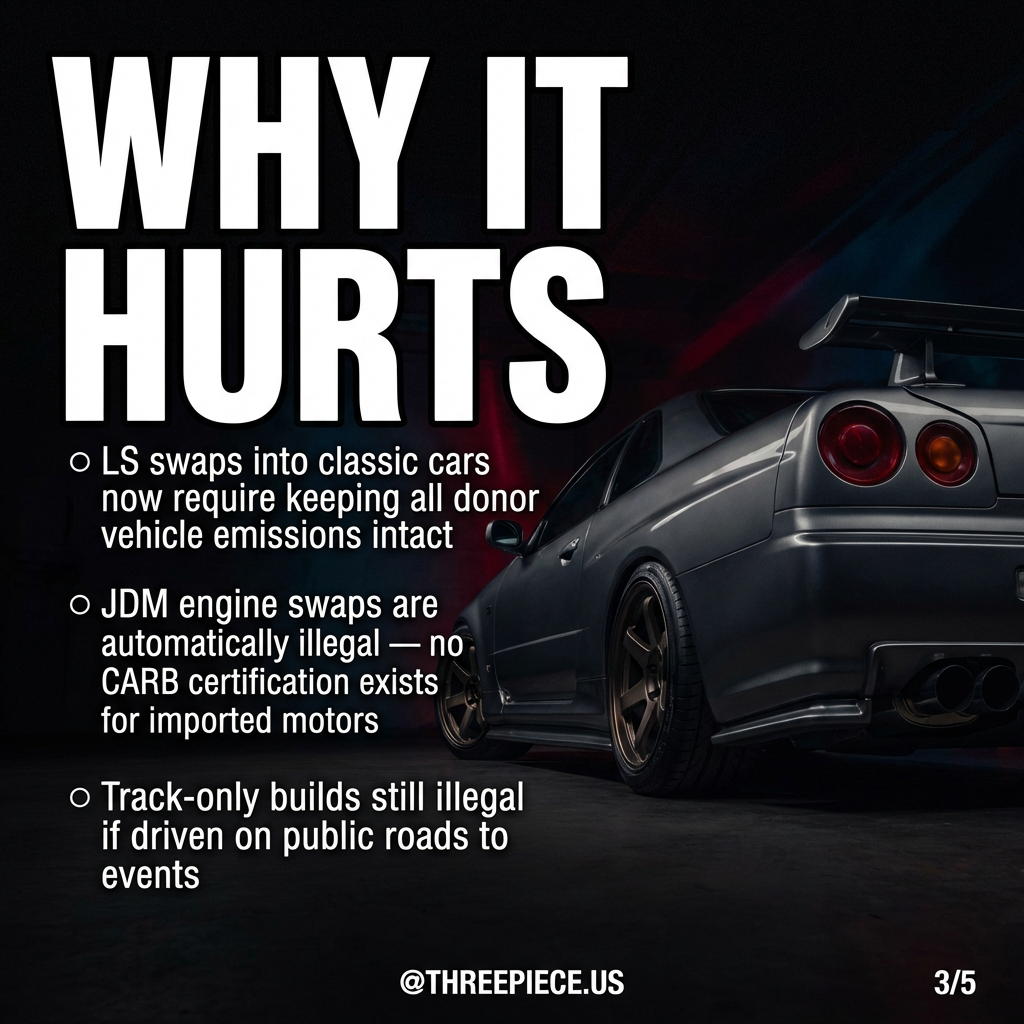
Even "track-only" builds are illegal if driven on public roads to events. That K24-swapped S-chassis you trailer to the track? Still illegal if you drive it to get gas or move it around the paddock on public roads. Our K20/K24 S-chassis swap guide covers the technical side, but the legal reality has shifted dramatically.
The enforcement targets three main groups: shops performing swaps, individual builders selling swapped cars, and anyone caught during routine traffic stops with obvious modifications. Insurance companies are also starting to flag swapped vehicles, as covered in our modified car insurance crisis article.
The Real Financial Impact
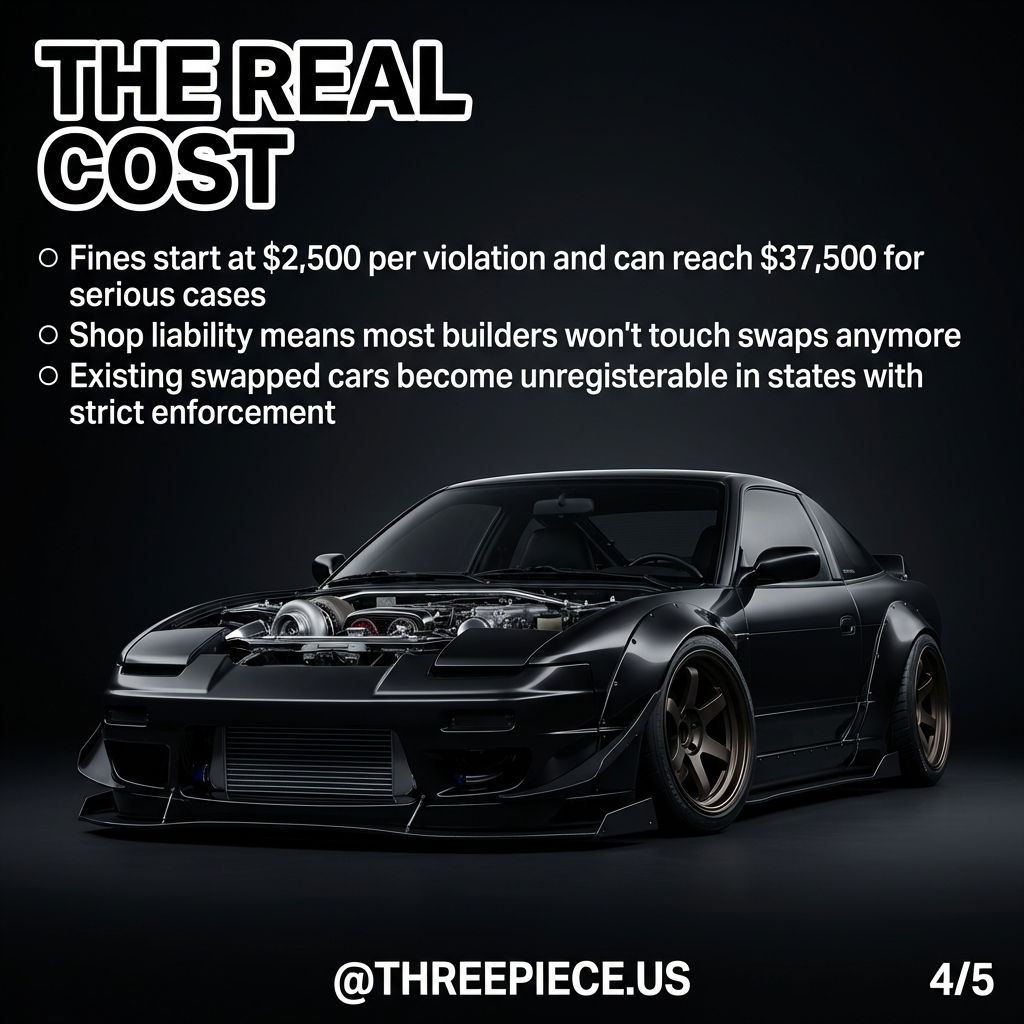
Fines start at $2,500 per violation and can reach $37,500 for serious cases. Shop liability means most professional builders won't touch swaps anymore — the risk isn't worth the profit margin. Existing swapped cars become unregisterable in states with strict enforcement, turning your investment into a very expensive lawn ornament.
The secondary market impact is already visible. Clean, stock examples of swap-worthy chassis are climbing in value while swapped cars are getting harder to sell. That 240SX you were planning to K-swap? Maybe consider keeping it stock and focusing on suspension and wheels instead. Check out our 17-inch 5x114.3 wheel options for a clean, legal build path.
Professional shops are shifting focus to bolt-on modifications that don't trigger federal oversight. Turbo kits, supercharger systems, and engine management on stock blocks remain legal as long as emissions equipment stays functional.
What Builders Need to Do Now
Document your build before new enforcement kicks in — grandfathering may apply to existing swaps with proper documentation. Take photos, keep receipts, and maintain records of when the swap was completed. Some states may offer limited protection for pre-existing modifications.

Consider states with weaker emissions testing if you're planning a move. Texas, Florida, and several other states have more relaxed enforcement, though federal law still applies everywhere. SEMA continues fighting but don't count on legal relief anytime soon — the organization's recent court losses suggest this interpretation will stick.
For new builds, focus on same-platform upgrades that don't require emissions equipment removal. A turbo K24 in a Civic remains legal as long as the catalytic converters and oxygen sensors function properly. Our K24 turbo build guide covers legal boost options.
Wheel and suspension modifications remain completely legal and can transform any car's performance. The Work Emotion series offers track-proven performance for any build, and quality tires like the Continental ExtremeContact Sport 245/45ZR18XL at $279 deliver real performance gains without legal risk.
The Future of Engine Swaps
The golden age of engine swaps may be ending, but smart builders are adapting. Electric swaps face fewer restrictions since they eliminate emissions entirely — though battery safety regulations are coming. Forced induction on stock blocks offers similar power gains without the legal headaches.
The focus is shifting back to chassis dynamics and driver skill development. A well-sorted suspension setup often delivers more real-world performance than raw power increases. Consider investing in proven components like quality suspension and proper tire sizing for maximum legal performance.
This regulatory shift forces the community to get creative within legal boundaries. The builders who adapt will find new ways to extract performance, while those who ignore the changes risk expensive consequences. The cars that matter most — the ones you can actually drive and enjoy — will be built within the rules, not around them.
Ready to build something legal and fast? Start with our wheel fitment fundamentals and browse our complete wheel selection for your next build. The best performance car is the one you can actually drive.